Author: Andrew Baird
The coral fauna of French Polynesia is an important part of the taxonomic puzzle. Tahiti, in particular, has been visited by numerous expeditions including the US Exploring Expedition, the British led Challenger Expedition, and more recently the Tara Oceans Expedition. All these expeditions collected specimens that serve as type material for some of the approximately 51 nominal species with a type location in French Polynesia. The well-travelled English taxonomist Cyril Crossland also spent time on Tahiti and named one species Favia ingolfi Crossland, 1931 from Pā’ea lagoon.
In November 2019, Andrew Baird from Project Phoenix visited CRIOBE on Moorea in search of topotypes for the 17 nominal species from the family Acroporidae. Some preliminary results from this trip have now been processed and reveal a deeply misunderstood coral fauna of great conservation significance. The results also throw another spanner in the works for coral reef scientist working in Australia and beyond.
From the 28 Acropora specimens included in our phylogeny and following comparison to the type material, we have developed 14 primary species hypotheses: six of these are currently accepted species according to WoRMS, two are junior synonyms and six are highly likely to be undescribed and potentially restricted to French Polynesia (Figure 1).
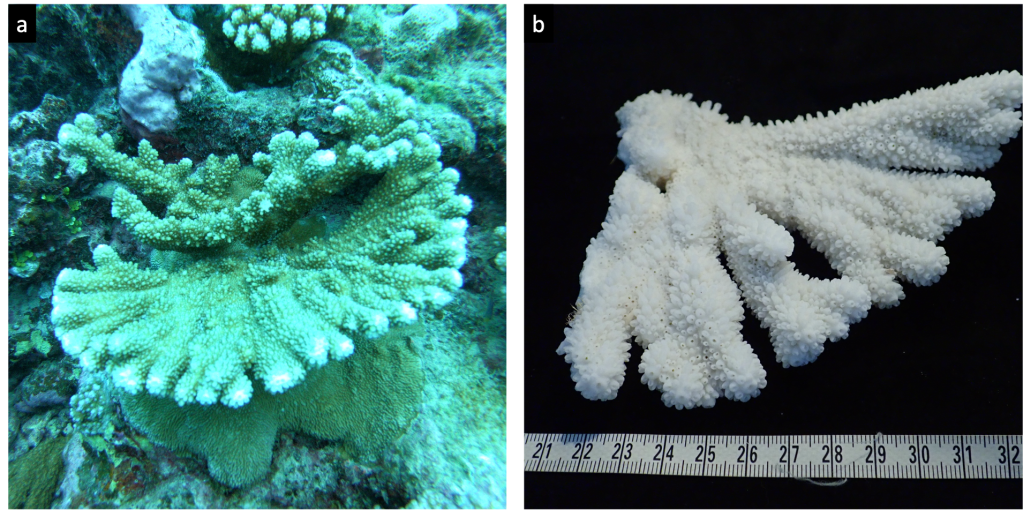
The Moorea specimens include topotypes for a number of species that are regularly used in experimental studies by scientists working on the Great Barrier Reef and Japan e.g., A. cytherea and A. nasuta (Figure 2). However, our molecular phylogeny, which now includes over 1600 specimens from throughout the Indo-Pacific, suggests that these species do not actually occur on the Great Barrier Reef or in Japan. The fact that 6 of the 14 PSH are potentially restricted to French Polynesia also suggests an unexpectedly high degree of endemism and therefore a fauna of high conservation significance.

The work was funded by the Australia Research Council through the ARC Centre of Excellence for Coral Reef Studies. Thanks to the staff and students at CRIOBE in particular, Dr Yannick Chancerelle for organising the collecting permits and advice on where to collect. The collections would not have been possible without Yannick’s help.
Literature cited
Crossland, C., 1931. The reduced building-power and other variation in the astrean corals of Tahiti, with a note on Herpetolitha limax and Fungia spp Proc. Zool. Soc. Lond., 1: 351-392.
Dana, J.D. (1846-1849). Zoophytes. United States Exploring Expedition during the years 1838-1842. Lea and Blanchard, Philadelphia. 7: 1-740, 61 pls.
 Project Phoenix