Author: Andrew Baird
Australia’s Indian Ocean Territories (IOT) are made up of Cocos (Keeling) Island and Christmas Island, 1000s of km to west of Western Australia. Cocos (Keeling) Island is one of the most isolated atolls in the world. Cocos (Keeling) Island is famous, among other things, for being the first atoll visited by Charles Darwin on the Beagle confirming for him that his theory of atoll formation had legs (Darwin 1842). The island has also been the site of a number of coral collecting expeditions over the years; Forbes in 1879 whose collection was described by Ridley and Quelch (1885); Wood-Jones 1906-07 whose collection was described by Vaughan (1918); Gibson-Hill in 1941 whose collection was described by Wells (1950) and Veron in 1989 (Veron 1990). Christmas Island is similarly remote, however, it is a high island with no lagoon but a considerable area of fringing reef. Numerous collections have also been made on Christmas Island (Andrews et al. 1900; Bernard 1900; Done and Marsh 2000; Richards and Hobbs 2014).
Veron (1990) presents a summary list that includes a total of 99 species in the Cocos (Keeling) Island collections. Richards and Hobbs (2014) list 147 species on Christmas Island. These collections also include the type specimens for 14 nominal species. However, these descriptions predate the use of molecular techniques. Hence the need to revisit these islands to collect tissue along with the skeletons and field images to allow us to test the validity of these lists. Andrew Baird and Tom Bridge visited Cocos (Keeling) Island and Christmas Island in May 2022 and Andrew Baird visited both again in September 2023.
The molecular data associated with the sampling trip in 2022 has just come back to the Project Phoenix analytical lab and the preliminary results are quite startling.
For Christmas Island, we now have 109 primary species hypotheses (PSH). At least three of these species are likely to be new to science and this number will also certainly rise once we can compare our specimens to a broader range of topotypes. For Cocos (Keeling) Island we now have 59 PSH, however, Andrew estimates that he collected another 15-20 species during September 2023. Among these 59 PSH are at least 5 undescribed species. One specimen of particular interest was a dead fragment of Goniopora collected on the beach at Scout Park. This is the first ever record of Goniopora on Cocos (Keeling) Island.
These preliminary estimates of species richness are slightly lower than previous estimates and low for tropical reefs in general, however, the degree of isolation, low habitat diversity and the small reef area all suggest low species richness on an island scale.
The samples include topotypes for all but one of the 14 nominal species with type location in the IOT: Acropora schmitti Wells, 1950. Our preliminary results suggest that most of the IOT nominal species that have been synonymised are good species, including Acropora pinguis, A. brooki, Montipora spongila and Porites gibsonhilli. In addition, they suggest that other IOT nominal species have been misinterpreted. For example, Veron’s (2000) interpretation of Montipora cocosensis Vaughan, 1918 is highly likely to be incorrect. Vaughan (1918) described M. cocosensis as ramose (i.e. closed branching) and the type fits rest of the description (Figs. 1a & d). Our topotype for M. cocosensis (Figs. 1b & e) has molecular affinities with other ramose species, such as M. digitifera. Veron (1990) criticises Vaughan’s choice of holotype, and then redescribes the species as massive or encrusting (Figs. 1c & f). There is, indeed, a massive Montipora sp. that is highly abundant in the lagoon at Cocos (Keeling) Island that matches Veron’s (2000) description. Our molecular results and comparison to the type materials suggests that M. cocosensis-sensu Veron is likely to be an undescribed species.

Similarly, we found nothing that matched Stylocoeniella cocosensis Veron, 1990 on Cocos (Keeling) Island, of which nominal name was derived from “…Cocos (Keeling) Atoll where the species was first observed” according to the author. The holotype of this species is highly distinctive with prominent plocoid corallites that are unique among the species of the genus Stylocoeniella. Eccentrically, the type location for S. cocosensis is Amitori Bay on Iriomote Island in southern Japan. During Andrew’s previous visits to southern Japan including Amatory Bay, he could find nothing to match the holotype of S. cocosensis; however has found a Stylocoeniella colony with plocoid corallites from southern Okinawa (Fig. 2). So, we suspect S. cocosensis is a good species, however, it probably does not occur on Cocos (Keeling) Island.

One conclusion arising from these preliminary results is that the fauna is more distinct than previously recognised. We estimate that there are at least 8 undescribed species in the IOT and many of these are likely to be endemic. Interestingly, there does not appear to be a huge overlap with the mainland Western Australian coral fauna especially in the genus Acropora. Indeed, the Acropora fauna has a surprisingly high affinity with that of southern-Japan although we stress that this result has yet to explored quantitatively. The Cocos (Keeling) Island Lagoon also contains one unusual habitat, the Blue Holes, that is small in area and which supports a number of potentially undescribed endemic species.
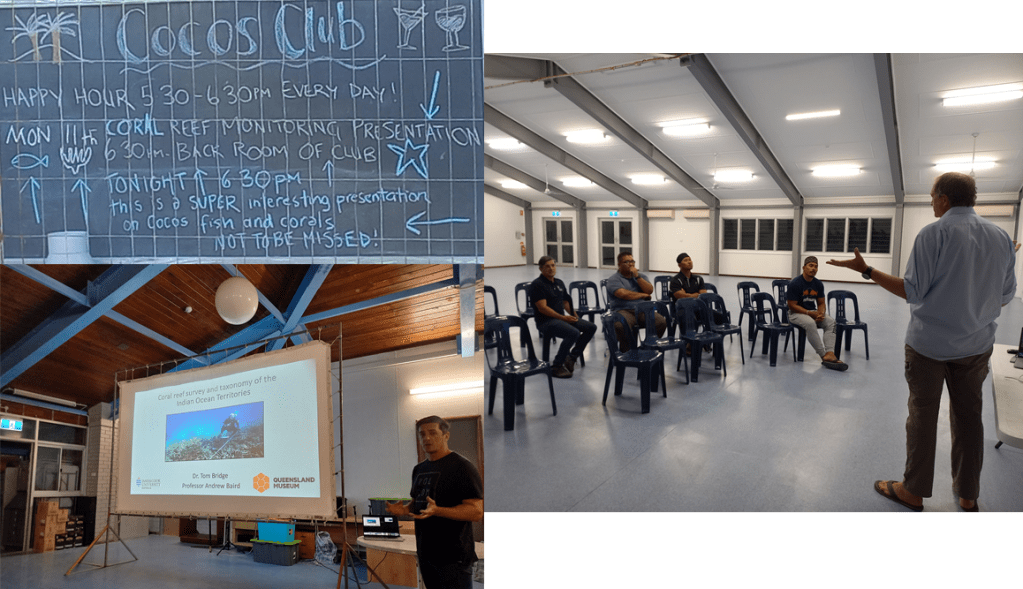
In addition to the coral collections, Andrew joined forces with JP Hobbs of Sea Country Solutions and Morgan Pratchett of James Cook University in a number of community engagement activities (Fig. 3) including:
- Training students on Christmas Island and some of the locals and tourists on Cocos (Keeling) Island in how to monitor coral health and abundance
- A workshop on how to determine the reproductive condition of Acropora corals.
- The goal here was to train some of the locals on Christmas Island to sample the Acropora assemblage throughout the year in order to establish when the corals have mature eggs which will be a good indication of when they are likely to spawn
- Three public lectures on our plans for research and monitoring of the coral reefs while on Cocos (Keeling) Island
- Two at the Cocos Club on West Island and one in the cyclone shelter on Home Island. These were well attended and well received, with many interesting questions and tips on where to look for particular species of fish and corals
Acknowledgements
We thank the ARC Centre of Excellence for Coral Reef Studies and Queensland Museum for funding the initial trip to the IOT; the Minderoo Foundation for providing the funding to sequence the specimens from that trip and Parks Australia for funding for field work in 2023. We also thank Gus Crosbie, Hanaka Mera and Julia Hung for work above and beyond the call of duty processing samples in the lab. On Christmas we thank Hama-san of Wet’n’Dry Adventures and on Cocos we thank Johnny Clunies-Ross and Peter McCartney of Cocos Blue Charters for getting us out to sea. We also thank Trish for helping organise the many talks on Cocos.
Literature cited
Andrews CW, Smith EA, Bernard HM, et al. (1900) On the Marine Fauna of Christmas Island (Indian Ocean). Proceedings of the Zoological Society of London 69:115-140
Bernard HM (1900) On the Madreporaria collected by Mr. C.W. Andrews at Christmas Island. Proceedings of the Zoological Society of London 1900:119-127
Darwin CR (1842) The structure and distribution of coral reefs. Smith, Elder & Co., London
Done TJ, Marsh L (2000) Reef-Building Corals Of Christmas Island. Records of the Western Australian Museum Supplement 59:79-81
Richards ZT, Hobbs JPA (2014) The status of hard coral diversity at Christmas Island and Cocos (Keeling) Islands. Raffles Bull Zool:376-398
Ridley SO, Quelch JJ (1885) III. List of Corals collected in the Keeling Islands. In: Forbes WA (1885) A naturalist’s wanderings of the Eastern Archipelago. A narrative of travel and exploration from 1878 to 1883. In pp.44-47
Vaughan TW. (1918). Some shallow-water corals from Murray Island (Australia), Cocos-Keeling Island, and Fanning Island. Papers from the Department of Marine Biology of the Carnegie Institution of Washington. 9 (213): 49-234, pls. 20-93.
Veron JEN. (1990). New Scleractinia from Japan and other Indo-West Pacific countries. Galaxea. 9: 95-173.
Wells JW. (1950). Reef corals from Cocos-Keeling Atoll. Bulletin of the Raffles Museum, Singapore. 22: 29-52.
 Project Phoenix