Author: Andrew Baird
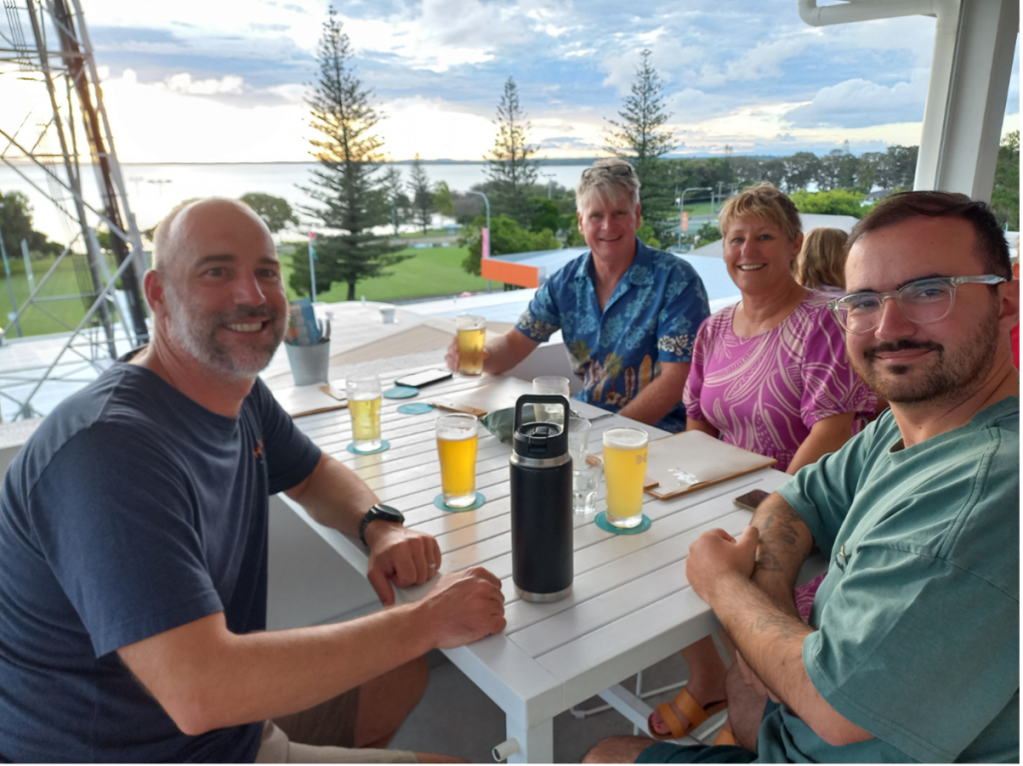
Andrew from James Cook University, Tom, Stefano and Merrick from Queensland Museum and Amanda from Queensland Parks and Wildlife Service visited the Moreton Bay Research Station on North Stradbroke Island in December 2024 (Fig. 1). The aim was to collect and curate all the hard coral species in the Moreton Bay region of south-east Queensland, Australia. The team visited five sites in the inner-Bay and four on Flinders Reef, a small, isolated rocky reef with extensive coral growth, 5 km north-east of Cape Moreton.
Among the muck in the inner-Bay, we managed to collect 83 specimens from approximately 51 species. In the clear and balmy waters of the east-Australian current on Flinders Reef – a rare treat given the logistical difficulties of getting to Flinders – we collected 89 specimens and took numerous photographs from which we estimate there are approximately 90 species.
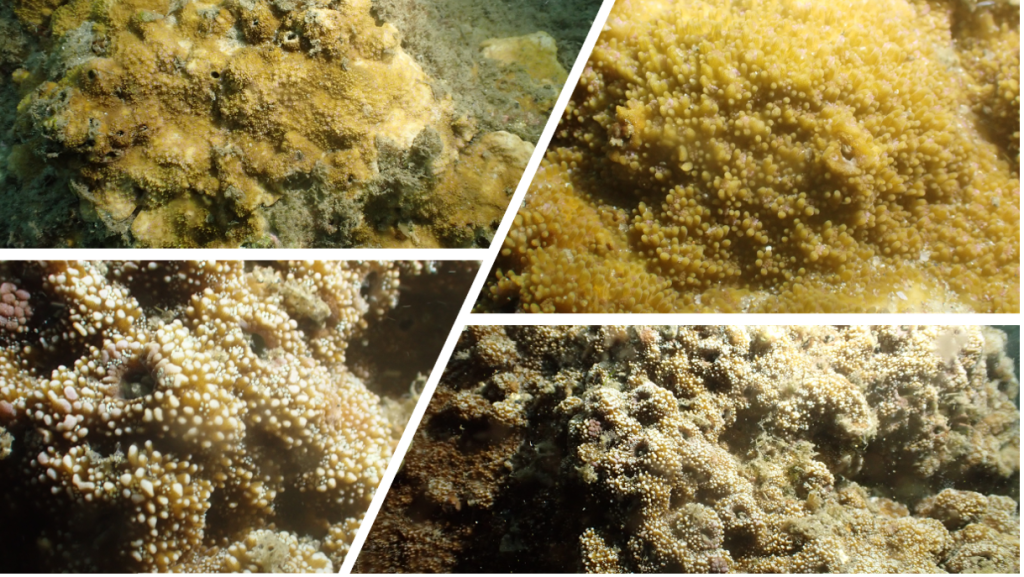
Moreton Bay is a site of significant ecological interest given its proximity to the Brisbane River and the city of Brisbane. Indeed, the marine ecosystem has been subjected to multiple flood events in recent years, and the inner-Bay was considered close to ecological extinction by Pandolfi et al. (2003). Our observations suggest that reports of the demise of the ecosystem in Moreton Bay are premature – at least with respect to the hard coral fauna. The Bay is far from pristine but coral cover is high in patches, there were few signs of disease or predators, many species are breeding and some taxa are either increasing in abundance or have recently recruited to the inner-Bay. For example, Pocillopora aff. damicornis was common at most of the sites we visited in the Bay, but was considered rare by Wallace et al. (2009). We found colonies of two species of Montipora on the sea wall at Amity Point boat ramp (Fig. 2) which is the first record of the genus in the inner-Bay. These colonies were unlikely to have been missed by Wallace et al. (2009) who would have sampled within meters of where we surveyed. We also sampled colonies of at least five species that contained mature gametes suggesting they were going to spawn following the full moon in December, confirming earlier predictions of the time of spawning in the inner-Bay by Fellegara et al. (2013).
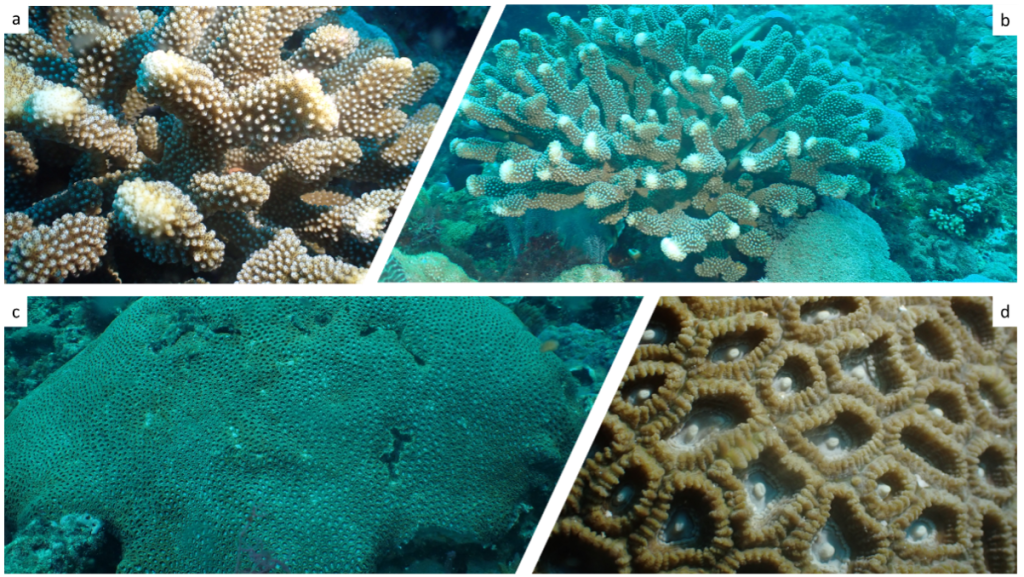
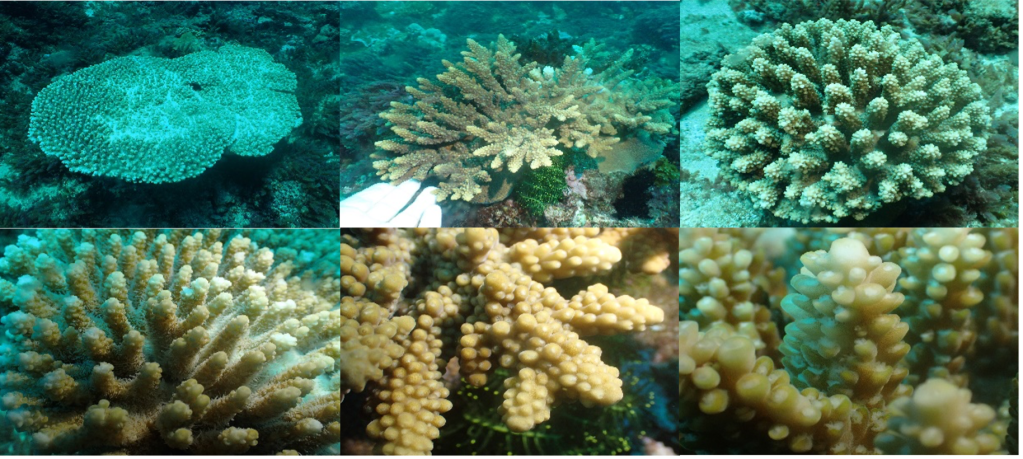
Flinders Reef occurs in an oceanic environment outside of Moreton Bay and supports more coral species than any other subtropical site in eastern Australia (Veron, 1993). The site is of significant biogeographical interest because it is situated in the path of the East Australian Current in a transition zone between tropical and temperate coral faunas (Veron, 1995; Sommer et al., 2018). Nonetheless, Veron (1995) interprets the coral fauna at Flinders as a depauperate tropical fauna, and suggests that all 113 species he records on Flinders Reef also occur on the Great Barrier Reef to the north (Veron, 1993). Our preliminary results suggests that the coral fauna has a much greater affinity with the coral fauna of the Tasman Sea to the south. In particular, we sampled a number of species that are rare or are absent on the GBR but are common on Lord Howe and in the Solitary Islands. We also recorded a couple of species for the first time on Flinders, e.g. Pocillopora cf. grandis and Lobophyllia cf. recta (Fig. 3), and we are also confident that there are at least two Acropora species that are new to all records collated by Project Phoenix and highly likely to be new to science (Fig. 4).
Thanks to the staff at Moreton Bay Research Station for a few excellent days at sea.
Literature cited
Fellegara, I., Baird, A. H. & Ward, S. (2013). Coral reproduction in a high-latitude, marginal reef environment (Moreton Bay, south-east Queensland, Australia). Invertebrate Reproduction & Development 57, 219-223.
Pandolfi, J. M., Bradbury, R. H., Sala, E., Hughes, T. P., Bjorndal, K. A., Cooke, R. G., McArdle, D., McClenachan, L., Newman, M. J. H., Paredes, G., Warner, R. R. & Jackson, J. B. C. (2003). Global trajectories of the long-term decline of coral reef ecosystems. Science 301, 955-958.
Sommer, B., Beger, M., Harrison, P. L., Babcock, R. C. & Pandolfi, J. M. (2018). Differential response to abiotic stress controls species distributions at biogeographic transition zones. Ecography 41, 478-490.
Veron, J. E. N. (1993). A biogeographic database of hermatypic corals. Townsville: Australian Institute of Marine Science.
Veron, J. E. N. (1995). Corals in space and time. Sydney: Southwood Press.
Wallace, C. C., Fellegara, I., Muir, P. R. & Harrison, P. L. (2009). The scleractinian corals of Moreton Bay, eastern Australia: high latitude, marginal assemblages with increasing species richness. Memoirs of Queensland Museum – Nature54, 1-118.
 Project Phoenix