Author: Andrew Baird
Spawning is upon us again on the Great Barrier Reef and I have just returned from a few days on Orpheus Island Research Station. I was helping Dr Carrie Sims of the Smithsonian Tropical Research Institute find mature Acropora colonies from which to produce planulae for her research on the early life history of corals. As these trips need to be organised months in advance, I must admit to feeling a little nervous we had chosen the correct dates. Carrie was relying on our predictions, based on solid evidence mind you (Mera et al. 2025), that spawning within Acropora assemblages in the Palm Islands is split every year. Following my advice, Carrie had committed to a 2-month stay on the island.
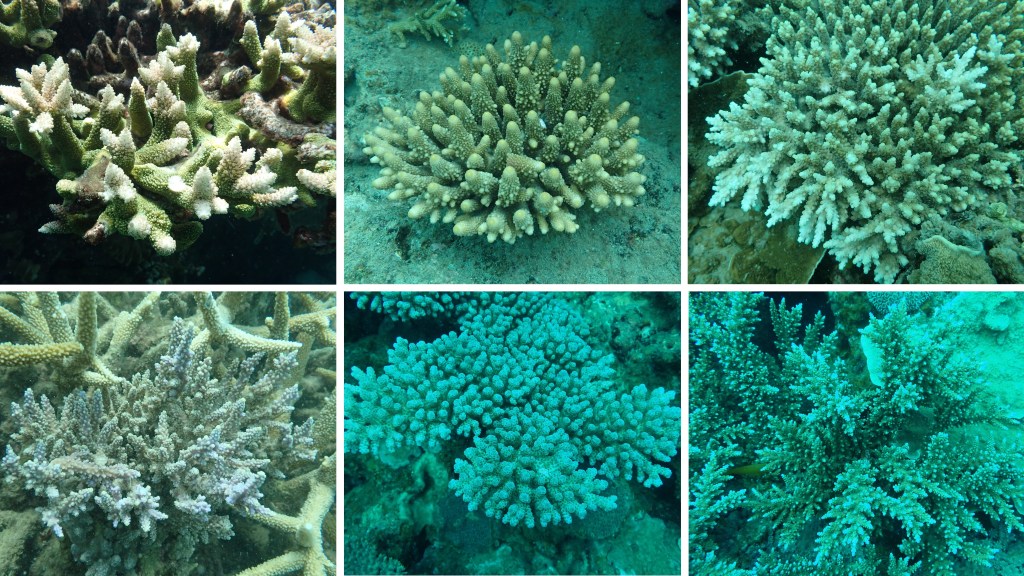
Once we got there, the coral reproductive condition data I collected clearly indicated that the main month of spawning on Orpheus this year was lunisolar moon month-5. This meant that the majority of Acropora colonies had already spawned following the full moon that fell in the beginning of November this year. So, it was with some relief that we still managed to find two Acropora species with sufficient number of colonies with mature eggs for Carrie to work with – indicating that they should spawn on or around lunisolar moon-6, early December for this year. Indeed, less than 5% of the 800 odd Acropora colonies we checked had mature eggs. Interestingly, this included at least one individual of 15 of the 36 morpho-species I sampled (Fig. 1), supporting our contention that spawning is split between months in quite a few species.
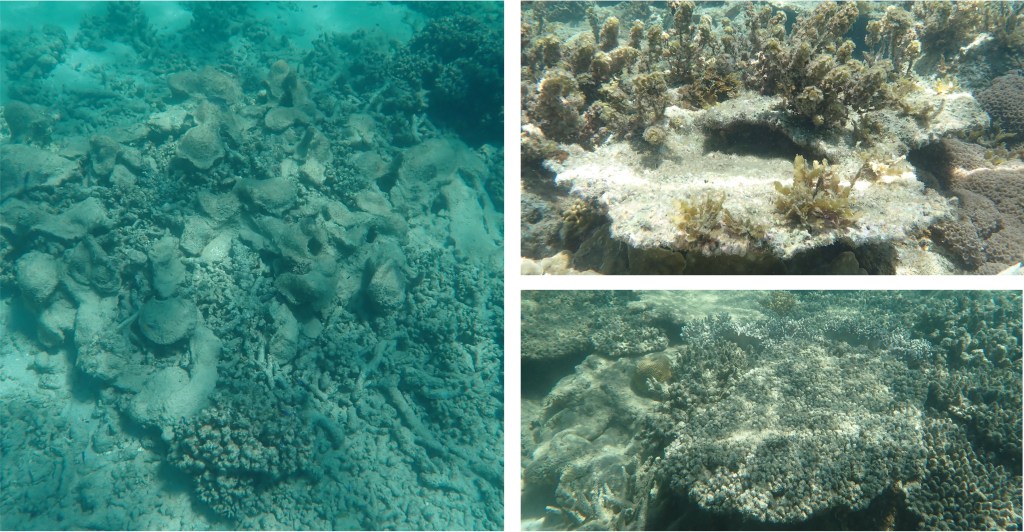
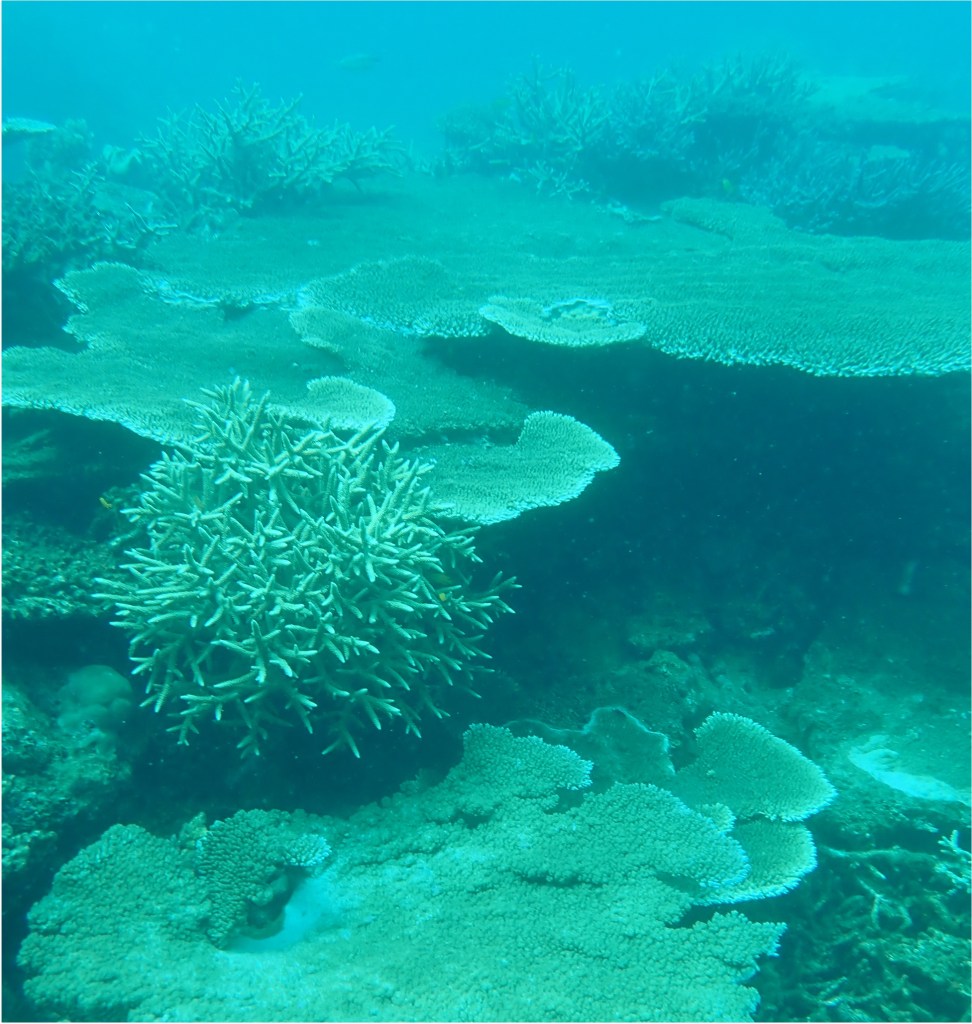
The condition of the reef was also a pleasant surprise. I had heard through the grapevine that the reefs on the eastern side of the Palm Islands had been badly affected by flooding earlier in 2025. While there was some serious damage in the shallows at a number or sites, in particular Indigo Bay and Falcon Island (Fig. 2), below approximately 1 m the reefs are still in very good shape. Some of the sites we visited were just magic, including the south-east of Curacao and the north-east of Pelorus (Fig. 3).
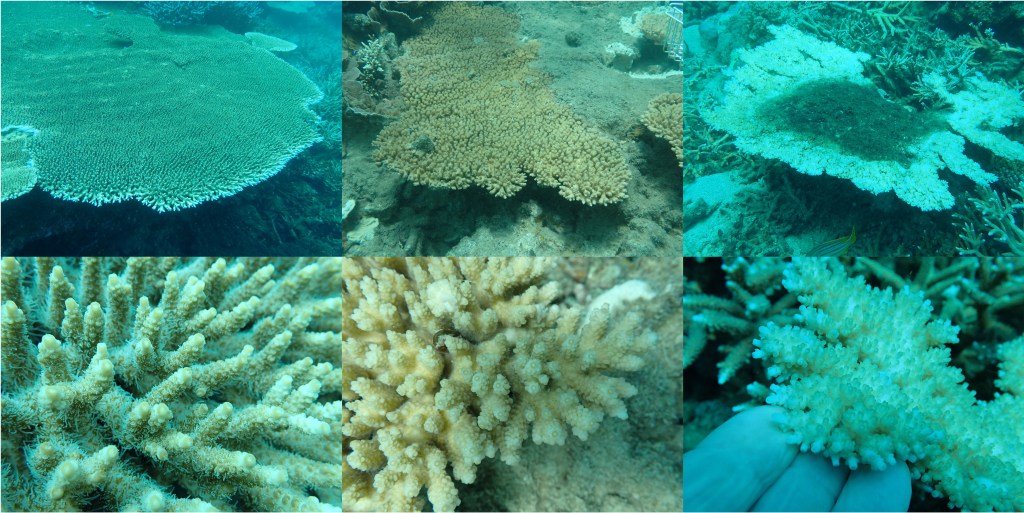
Having finally freed myself from the shackles of the Veron and Wallace taxonomic framework, the diversity of the Acropora assemblage and its novelty, is striking. I am starting to get a hang on how to distinguish the hyacinthus-like tables, thanks largely to the work of Sage Rassmussen (Rassmussen et al. 2025), and there are at least three other undescribed table species in the Palms (Fig. 4). Other groups, such as the humilis species complex are proving more of a challenge, as are the open branching species. However, thanks to our integrated taxonomic approach, I can be confident that when an Acropora morpho-species is consistently different from those around it, it is distinct and then, thanks to our curation of all the type materials for the genus Acropora, I can also determine if it is undescribed (Fig. 5).
Thanks to Lachie and the crew at OIRS and Amber and Dani, Carrie’s excellent interns.
Disclaimer: The opinions expressed in this article are my own and do not necessarily reflect those of Project Phoenix more generally.

Literature cited
Mera H, Edwards AJ, Guest JR, Lachs L, Quigley KM, Willis BL, Baird AH (2025) Patterns of coral spawning in the Palm Islands, Great Barrier Reef. Coral Reefs 44:1789–1803
Rassmussen SH, Cowman PF, Baird AH, Crosbie AJ, Quattrini AM, Bonito V, Sinniger F, Harii S, Cabaitan PC, Fadli N, Tan C-H, Hung JY-H, Rongo T, Huang D, Halafihi T, Bridge TCL (2025) The tables have turned: taxonomy, systematics and biogeography of the Acropora hyacinthus (Scleractinia: Acroporidae) complex. Invertebr Syst 39:IS24049
 Project Phoenix