Author: Andrew Baird
Nominal species: Madrepora protoeiformis Saville-Kent, 1897
One of the more distinctive corals on the reefs of Ningaloo (Western Australia) is Acropora protoeiformis originally described by Saville-Kent in 1897 in his classic travelogue “The Naturalist in Australia”, with his characteristic flourish:
“To return to the subject of the Abrolhos corals, there was one form … notable for its usually pale sage-green hue, and the remarkable diversity in the contour of its coralla. In some instances, it formed robust, shortly branching, bush-like growths; in others fan-like expansions, or even encrusting masses, or it might be a combination of these types.”
Saville-Kent, 1897
Saville-Kent published three beautiful photographs of the species from which is immediately apparent the shape and form this species might take underwater. One of these images is included below along with a field image of a colony at Oyster Stacks on Ningaloo Reef.
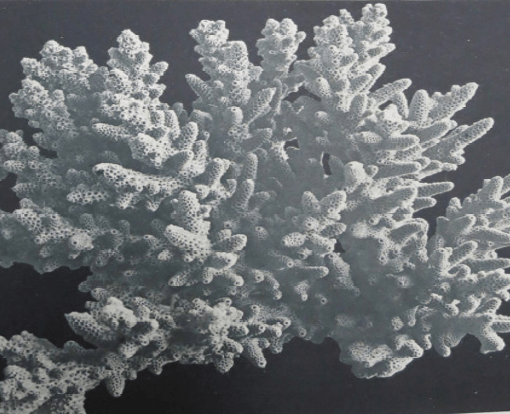

Unfortunately, we have yet to locate any of these specimens in the British Natural History Museum where they were deposited by Saville-Kent in 1895. We plan to designate a neotype if these specimens do not turn up shortly.
Veron & Wallace 1984 list A. proteoformis in their nomenclature but otherwise do not discuss the validity or otherwise of this species. Wallace (1999) lists the species in her nomenclature stating that the “holotype?” is lost and that its status is unresolved. However, once having encountered this species in the field and examined how closely the skeleton matches the images in Saville-Kent 1897, it is clear that this is a good species.
Saville-Kent finishes his description of Acropora protoeiformis with what is clearly a dig at his colleague at Yale University, Dr A. E. Verrill, who was famous for describing new species based on small fragments of colonies that were often in very poor condition. Unfortunately, this includes many species of Acropora (e.g. A. paniculata Verrill 1902) that are proving difficult to resolve because the type material is not up to scratch:
“They [the specimens] there constitute a most instructive object lesson for the benefit of those systematic zoologists with whom small or fragmentary specimens alone have been hitherto available for classificatory purposes.”
Saville-Kent, 1897
Literature cited
Saville-Kent, W (1897) The naturalist in Australia. Chapman and Hall, London. Pp. i-xv, 1-302. Plates 1-50, chromo plates 1-9.
Veron, JEN, Wallace, CC (1984) Scleractinia of Eastern Australia – Part V. Family Acroporidae. Australian Institute of Marine Science Monograph Series 6: 1–485.
Verrill AE. (1902) Notes on corals of the genus Acropora (Madrepora Lam.) with new descriptions and figures of types, and of several new species. Transactions of the Connecticut Academy of Arts and Sciences. 11: 207-266, pls. 36, 36A-F.
Wallace CC (1999) Staghorn corals of the world. CSIRO, Collingwood
 Project Phoenix