Author: Andrew Baird
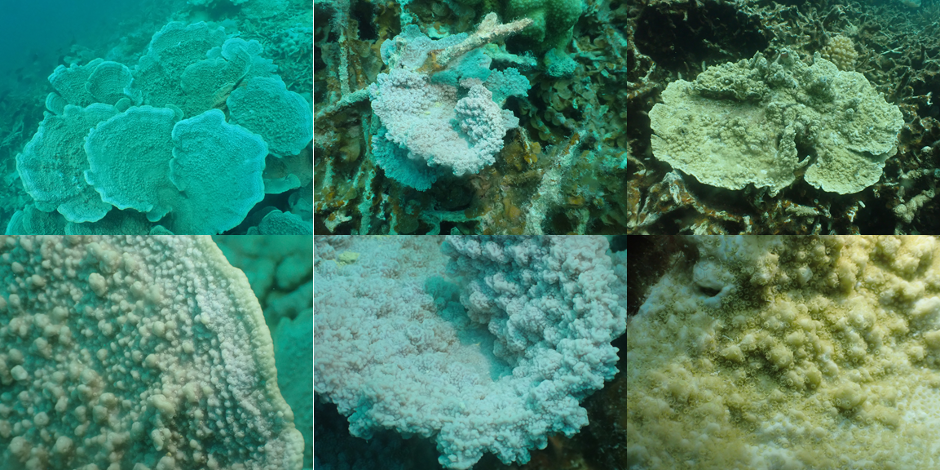
The Blue Holes at the southern end of the Cocos Island Lagoon seem to be a particular rich habitat in terms of novel species with potentially three new Montipora species (Fig. 1). The Blue Holes are a highly unusual habitat and very prominent in the lagoon when viewed on Google Earth. The holes are mostly circular and range in size from 10s to 100s of metres in diameter, with a maximum depth of 5-12 m; some are highly turbid, other reasonably clear, some are coral graveyards littered with the skeletons of dead colonies, others contain extensive monospecific stands of Echinopora cf. lamellosa or various staghorn Acropora species.
Reports suggest that corals in the lagoon are periodically destroyed by hypoxic events (Veron 1990; Hobbs and McDonald 2010) however, the fact that these species persist, despite appearing to be only found in the Blue Holes, indicates that these species must have some refuge during such events. Another significant species, only found to date in the Blue Holes is Anacropora forbesi Ridley 1884. This is the type species for the genus and the type location is Cocos Islands. We have only seen one living specimen of this species to date.
Literature Cited
Hobbs JPA, McDonald CA (2010) Increased seawater temperature and decreased dissolved oxygen triggers fish kill at the Cocos (Keeling) Islands, Indian Ocean. J Fish Biol 77:1219-1229
Veron JEN (1990) Re-examination of the reef corals of Cocos (Keeling) Atoll. Rec West Aust Mus 14:553-581
 Project Phoenix
Pingback: The Indian Ocean Territories (IOT), Australia | Project Phoenix