Author: Andrew Baird
Nominal species: Leptoseris amitoriensis Veron, 1990
This note outlines some excellent detective work conducted by a group of Japanese coral scientists (Fujii et al. 2018) to establish that fragments of the holotype of Leptoseris amitoriensis Veron 1990, which was thought to be lost, do indeed exist. In addition, like many of these notes, there is also a moral to the story: keep good notes when collecting your specimens, pay attention to detail and do not expect to rely on your memory to reconstruct your sampling efforts.
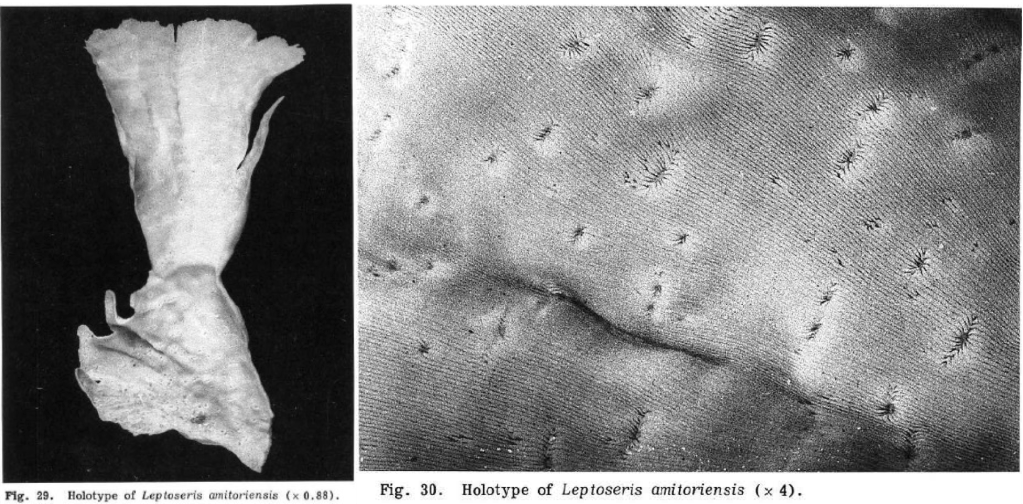
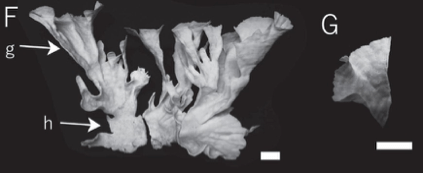
Veron (1990) claims to have based his original description on five specimens collected by H. Yokochi from Amitori Bay on Iriomote in southern Japan. In Fujii et al. (2018), the very same H. Yokochi states that he only collected one specimen. Fujii et al (2018) present a figure that convincingly demonstrates that the holotype imaged by Veron (1990) is a fragment of a larger colony that is now in four pieces: the specimen designated by Veron as the holotype (G32481) imaged in Figs. 29 & 30 in Veron (1990) (Also in Fig. 1, present article) and three other specimens, CMNH-ZG 08451, RUMF-ZG-04388 and RUMF- CMNH-ZG-04389, referred to by Fujii et al (2018) as paratypes (Fig. 2). (Abbreviations: CMNH = Chiba Prefectural Central Museum Annex Sea Museum and RUMF = the Ryukyu University Museum Fujukan).
In fact, if these specimens are fragments of the holotype, the consensus is that all the fragments should considered holotypes, although I cannot find an article in the Code of Zoological Nomenclature that specifically deals with this issue.
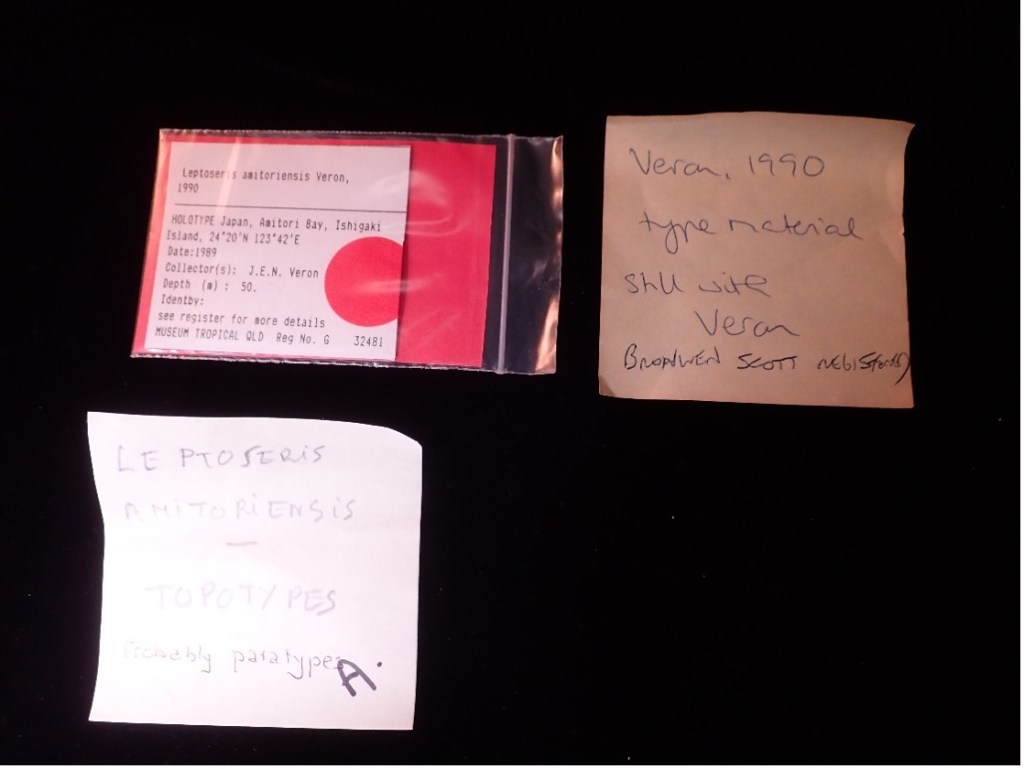
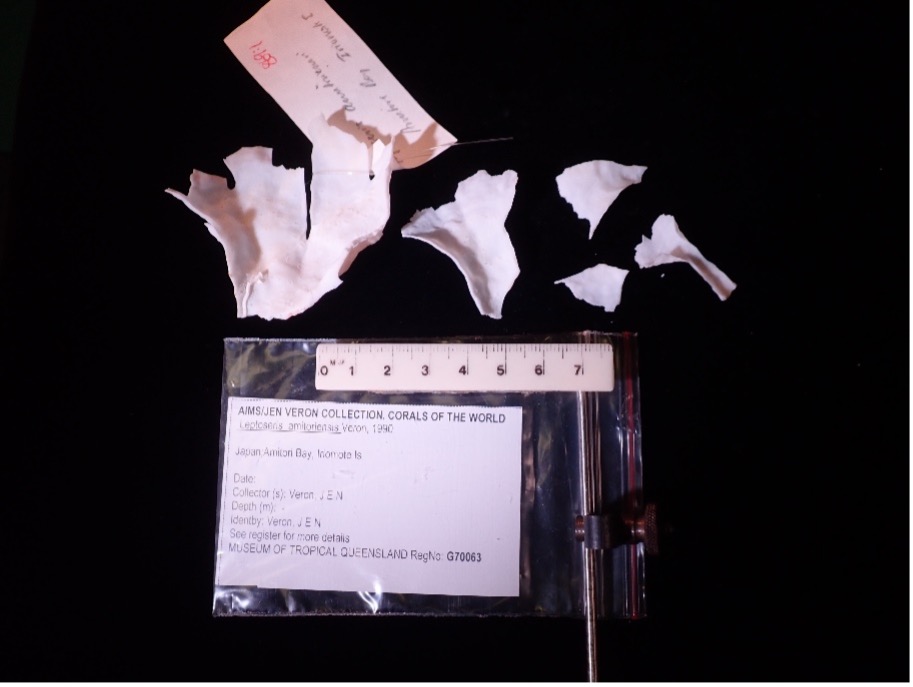
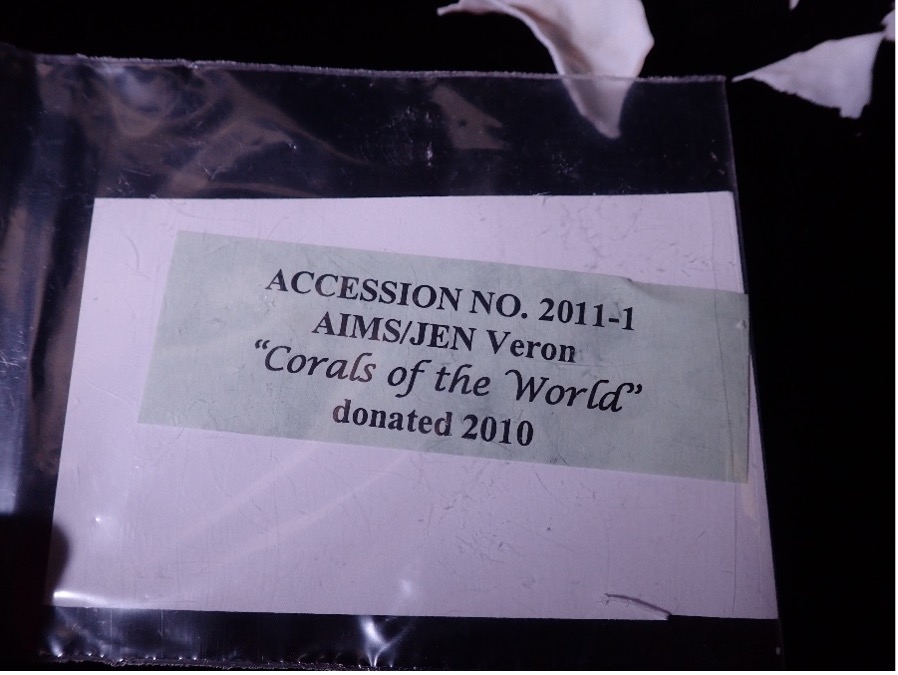
The Queensland Museum Tropics (MTQ) collection includes the label of the holotype with a note that “type material still with Veron” (Fig. 3). In addition, there are four more lots at MTQ with registration numbers G70061, G70062, G70063, G70064. These lots include between 1 and 5 fragments with labels suggesting they were collected by Veron from Amitori Bay, although there is no date of collection on the label (Fig. 4). They are almost certainly specimens of L. amitoriensis, however, they are not specifically mentioned by Veron in the original description and therefore should not be a part of the type series and are probably best considered as vouchers and topotypes. Another label with the lot G70063 with accession number 2011-1 suggests these specimens were given to the Museum in 2011 (Fig. 5). Veron was recently quizzed on the provenance of these specimens and replied that he could not remember, which is fair enough, but a good lesson we can all learn from in the importance of keeping good field notes when collecting.
Literature cited
Fujii, T., H. Tachikawa, and H. Yokochi. 2018. First record of the coral Leptoseris amitoriensis (Scleractinia, Agariciidae) from Amami-oshima. Taxa, Journal of the Japanese Society of Systematic Zoology 44:52–57.
Veron, J. E. N. 1990. New Scleractinia from Japan and other Indo-West Pacific countries. Galaxea 9:95-173.
 Project Phoenix