Author: Sage Rassmussen
Nominal species: Acropora tersa Rassmussen, Bridge & Baird, 2025
Meet Acropora tersa, a coral that you may already know. This newly described species has been hiding in plain sight for years on the Great Barrier Reef (GBR) and across much of the western Pacific, often mistaken for its close relative, A. hyacinthus. Its journey to a formal name began on the 2019 Voyage of the Kalinda, a taxonomic expedition across the GBR where specimens were collected and this new lineage was first hypothesised.
During this expedition, and on subsequent research trips, this distinctive coral was affectionately nicknamed Acropora ‘neat’ to differentiate it from A. hyacinthus due to the regular arrangement of radial corallites of similar shape and size and compact branches. This informal name stuck and eventually inspired its formal scientific name, tersa, which is Latin for neat, clean, or elegant—a perfect descriptor for this tidy coral.
How to tell them apart: A. tersa vs. A. hyacinthus
Although these two species often live together (in sympatry) there are several key features to help you distinguish A. tersa from A. hyacinthus:
- Colour: A. hyacinthus, especially on the GBR, is often a vibrant pink, usually with distinct orange ring on the top of the axial corallite wall. Acropora tersa, by contrast, has a more pastel palette of pink, purple, blue and green and lacks the dark axial ring.
- Structure: True to its name, A. tersa has a distinctively neat, uniform, and compact final branching structure. This is what sets it apart from the more open, often irregular branching pattern of A. hyacinthus.
More images can be found on the publication.

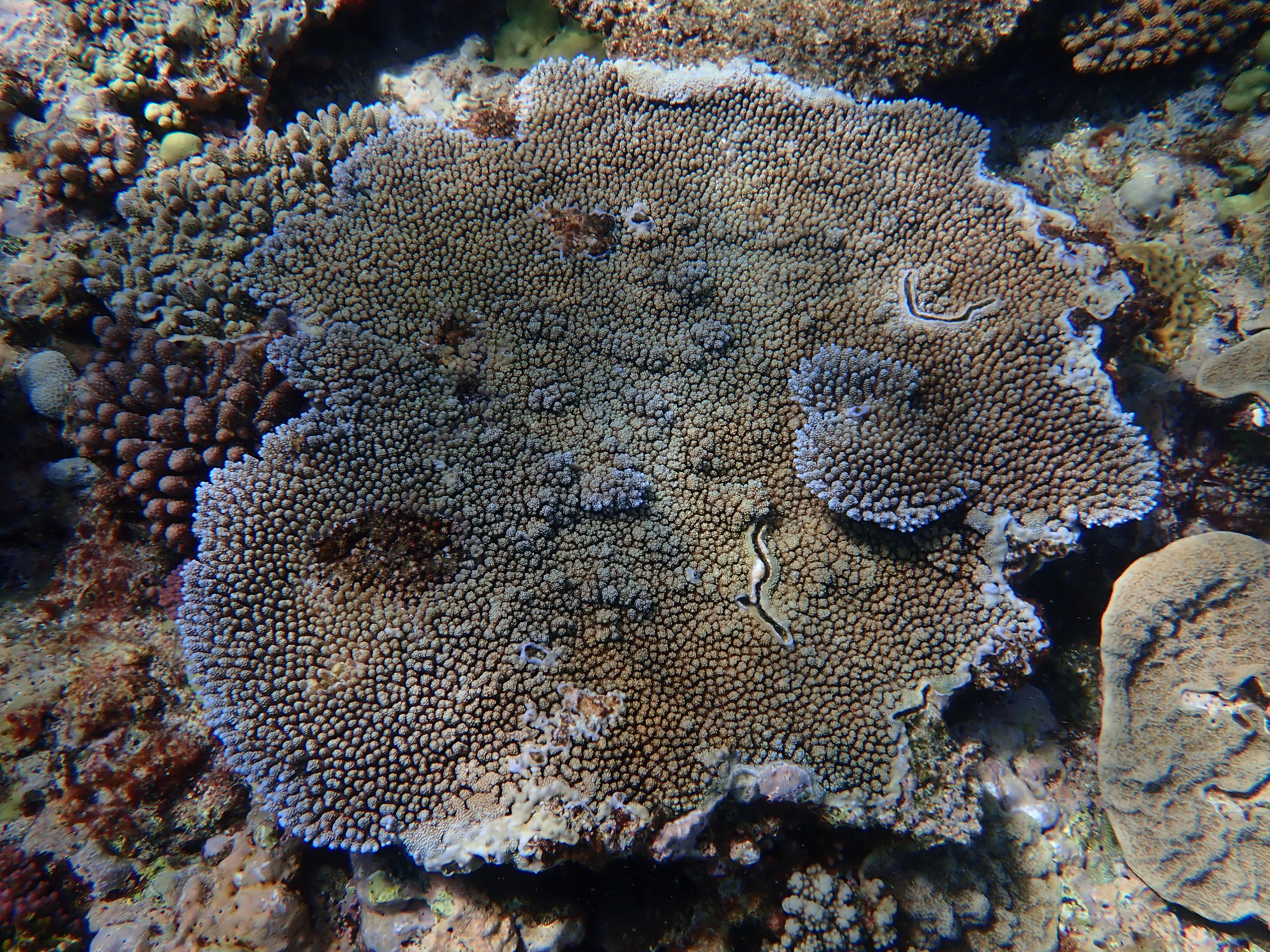


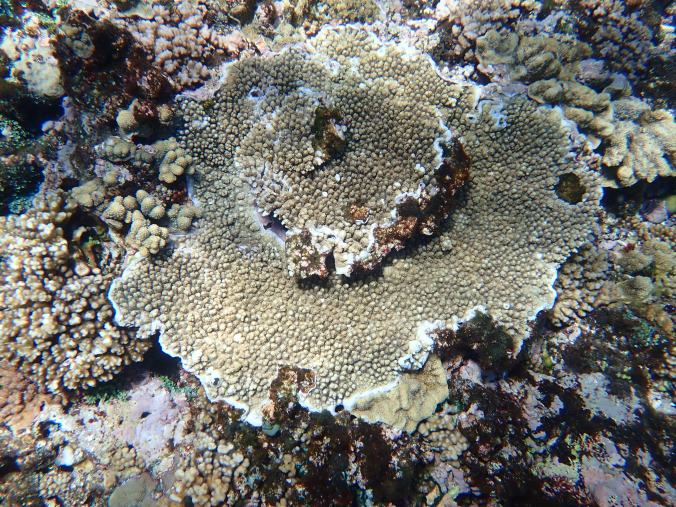
Acropora tersa in publications prior to formal description
Describing a new species can take years. Prior to the formal description of A. tersa by Rassmussen et al. (2025), several research projects, sometimes inadvertently, used this species but through consultation with Project Phoenix prior to publication, they were able to distinguish their study species from A. hyacinthus. This highlights the importance of collaboration with taxonomists when planning research that requires accurate species identification, as well as including detailed descriptions and images in publications where taxonomic identity is uncertain.
For example, Howlett et al. (2024), discovered two distinct genetic lineages in a population-genetic study of A. hyacinthus on the GBR. Following consultation with PP and thanks to their detailed in-text description “notably distinct due to their compact branchlet formations” and images in Figure 3E-F, this lineage can now be confidently identified as A. tersa.
Similarly, following consultation with PP, Suggett et al. (2021) chose to describe a “pastel-like colony colouring, distinctly compact and uniform growth and spacing of vertical branchlets with no exert axial tip” as “A. hyacinthus sp-2” once again, almost certainly the newly described A. tersa.
In the above studies, the identification occurred after the project commenced. However, ideally taxonomic experts should be consulted before sampling begins.
For example, Naugle et al. (2024) specifically targeted the Acropora ‘neat’ morphotype for their study. They were not able to use the name A. tersa because it hadn’t been formally described, however, the authors’ detailed description of their coral “characterized by tightly packed and neatly arranged vertical branchlets… tightly reticulate basal branches, and a neater oval-shaped tabular structure”—and images in Figure 3B1 provide clear evidence that the study species was A. tersa. While the study sampled other tabular species in addition to A. tersa, the inclusion of specimens collected by PP and registered in the Queensland Museum collection ensured that each lineage could be confidently identified.
The unintentional sampling of this species leads us to a fascinating question: is A. tersa more common or more resilient than its close relatives? Its distinctive features make it easy to spot, but does it have a higher tolerance for stressors like bleaching or disease? The data gathered from these collaborative studies provide a foundation for answering these important questions and for future research on the Great Barrier Reef.
Interesting Facts
- On the GBR, particularly in the southern region (e.g., around the Capricorn and Bunker Group), A. tersa has been observed forming encrusting colonies on the reef crest. However, A. tersa is much rarer in the southernmost sections of the GBR than it is further north.
- A. tersa co-occurs with several other tabular Acropora species previously misidentified as A. hyacinthus, including A. pectinata (formally resurrected from synonymy) and a currently undescribed lineage known as A. sp. VI-B (Rassmussen et al. 2025).
- In the southern GBR, A. tersa is also found alongside the newly described A. harriottae. Determining how to distinguish these two species, along with A. hyacinthus, where they co-occur is a subject of ongoing research. This is primarily because colonies at high latitude do not always possess the same morphological characters as in more tropical locations.
Literature Cited
Howlett, L., Camp, E. F., Locatelli, N. S., Baums, I. B., Strudwick, P., Rassmussen, S., & Suggett, D. J. (2024). Population and clonal structure of Acropora cf. hyacinthus to inform coral restoration practices on the Great Barrier Reef. Coral Reefs, 43(4), 1023-1035.
Naugle, M. S., Denis, H., Mocellin, V. J., Laffy, P. W., Popovic, I., Bay, L. K., & Howells, E. J. (2024). Heat tolerance varies considerably within a reef-building coral species on the Great Barrier Reef. Communications Earth & Environment, 5(1), 525.
Rassmussen, S. H., Cowman, P. F., Baird, A. H., Crosbie, A. J., Quattrini, A. M., Bonito, V., … & Bridge, T. C. (2025). The tables have turned: taxonomy, systematics and biogeography of the Acropora hyacinthus (Scleractinia: Acroporidae) complex. Invertebrate Systematics, 39(8).
Suggett, D. J., Nitschke, M. R., Hughes, D. J., Bartels, N., Camp, E. F., Dilernia, N., … & Warner, M. E. (2022). Toward bio‐optical phenotyping of reef‐forming corals using Light‐Induced Fluorescence Transient‐Fast Repetition Rate fluorometry. Limnology and Oceanography: Methods, 20(3), 172-191
 Project Phoenix
Pingback: Orpheus Island Research Station November 2025 | Project Phoenix