Author: Andrew Baird
I have just returned from a research trip to Kenya. The trip included a workshop on coral taxonomy and a field trip to the coral reefs of Shimoni including a visit to Kisite Mpunguti Marine Park & Reserve.
The corals of Kenya are very poorly known. To the best of my knowledge, no coral specimens have been collected in the country to date. Indeed, there are only 26 nominal species from the entire east coast of Africa south of Eritrea, including 20 from Tanzania, one from Mozambique and five from South Africa (Crosbie et al. 2026).
Previous species lists for Kenya suggest there are between 110 (Muthiga 2016) and 301 hermatypic coral species (Veron et al. 2011) and that the coral fauna has strong affinities with areas to the east and south including Madagascar, the Mascarene Islands and the Seychelles (Obura 2012). However, there are significant problems with these historical lists. Firstly, they are based on surveys rather than collections, and secondly, the lists include many species that were originally described from sites in the Pacific Ocean. Recent phylogenomic research suggests that few, if any, Acropora or Pocillopora species with type locations in the Pacific Ocean will also occur in Indian Ocean (Oury et al 2023; Bridge et al 2024; Rassmussen et al 2025). Examples include several species thought to be common in Kenya such as Acropora divaricata, A. hyacinthus, A. tenuis & A. valida, all of which were described by James Dana (1846) based on specimens collected in Fiji. Indeed, 22 of the 42 Acropora species recorded in Kenya by Obura (2012) have a type location in the South Pacific. Insights like this highlight the need for the coral fauna to be reevaluated using modern integrated taxonomic approaches (Cowman et al 2020; Bonito et al 2021).
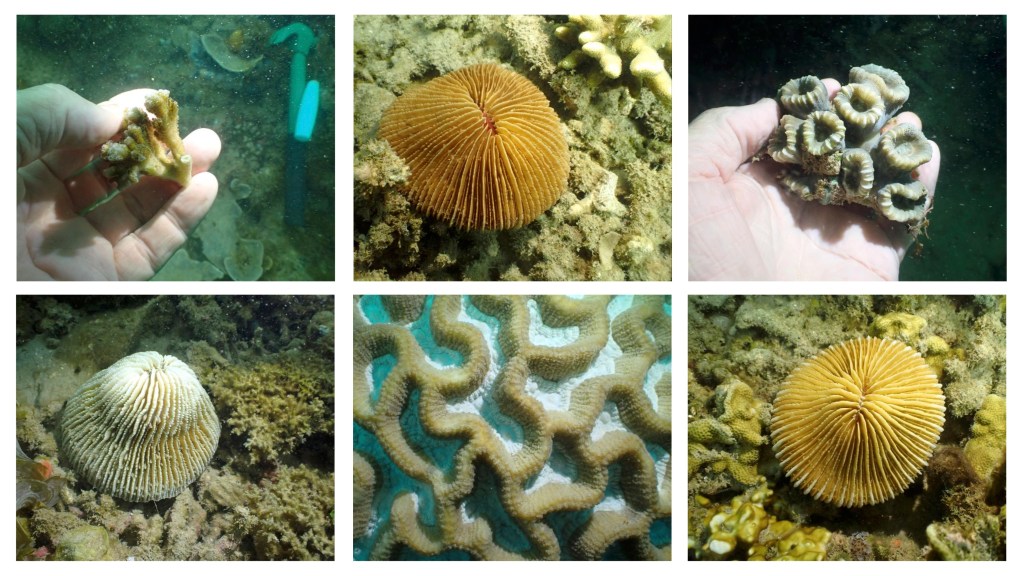
The research is led by Dr Sammy Wambua of Pwani University, Kilifi, Kenya and Dr Ewout Knoester of the REEFolution Foundation and Wageningen University & Research and includes colleague from the Kenya Wildlife Service (KWS) and the Wildlife Research & Training Institute (WRTI), and is funded by Research & Conservation Support Society (RECOURSE) through the Revive & Restore, Catalyst Science Fund. The main aim of the project is to find molecular tools for species identification that are cheaper and easier than the current next generation sequencing approaches, such as targeted capture of ultraconserved elements (Cowman et al 2020) or shallow genome sequencing (Quattrini et al 2024). The research will focus on 12 species common in Shimoni, including some used in local restoration efforts. However, the research also presented an opportunity for a visual reassessment of the coral biodiversity of the region in the light of the new taxonomic framework being developed by Project Phoenix. The team spent 4 days collecting in Shimoni. The collections were assisted by the willing help of several volunteers from REEFolution and local park rangers.
The reefs were generally in reasonable health except for some sites and taxa that were badly affected by bleaching in 2024. For example, we only saw about five living colonies of tabular Acropora in over 2 hrs underwater in the Marine Park, and dozens of dead colonies. At other sites, coral cover was reasonably high and there was little disease or evidence of other stress.
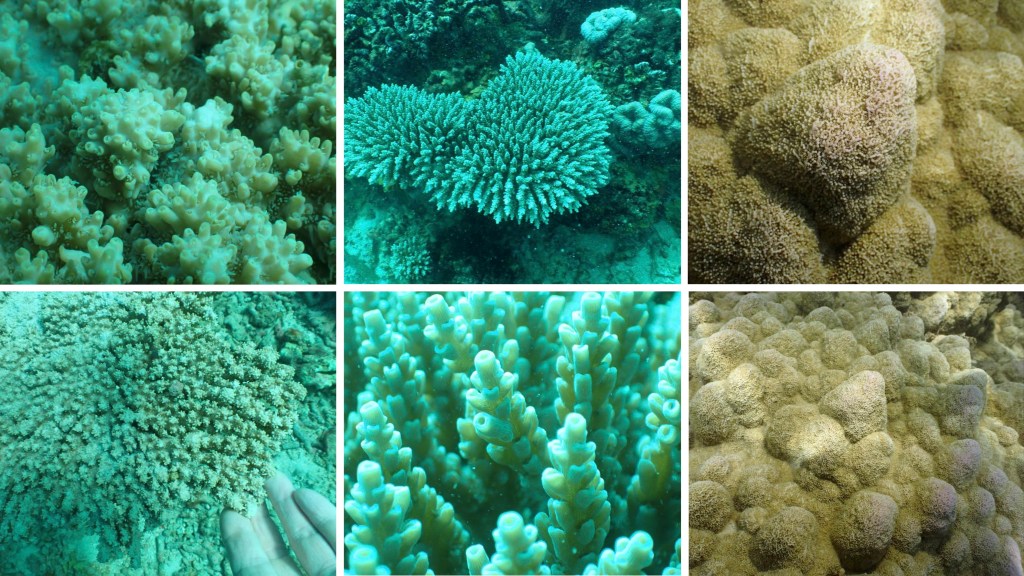
We collected a total of 204 specimens, representing approximately 50 different morpho-species, very few of which we can identify with any certainty. In addition, we photographed a total of between 140 and 160 species. The collection includes several type II topotypes (Fig. 1) and some potentially undescribed species (Fig. 2). The coral fauna has clear affinities with that of the Seychelles based on a recent collecting trip by Project Phoenix in May 2025 and there are also several species that are found in the Red Sea.
The specimens will form the basis of the first curated collection of the corals of Kenya at the National Museum of Kenya. Hopefully, the results of our research will help secure funding for a more complete collection to better assess the species richness and affinities of Kenya’s coral fauna.
Acknowledgements
Thanks to Firefly Eco Retreat for looking after us on land and sea and for all the participants in the
coral taxonomy workshop.
References
Bonito VE, Baird AH, Bridge T, Cowman PF, Fenner D (2021) Types, topotypes and vouchers are the key to progress in coral taxonomy: Comment on Wepfer et al. (2020). Mol Phylogen Evol 159:107104
Bridge TCL, Cowman PF, Quattrini AM, Bonito VE, Sinniger F, Harii S, Head CEI, Hung JY, Halafihi T, Rongo T, Baird AH (2024) A tenuis relationship: traditional taxonomy obscures systematics and biogeography of the ‘Acropora tenuis’ (Scleractinia: Acroporidae) species complex. Zool J Linn Soc 202
Cowman PF, Quattrini AM, Bridge TCL, Watkins-Colwell GJ, Fadli N, Grinblat M, Roberts TE, McFadden CS, Miller DJ, Baird AH (2020) An enhanced target-enrichment bait set for Hexacorallia provides phylogenomic resolution of the staghorn corals (Acroporidae) and close relatives. Mol Phylogen Evol 153:106944
Crosbie AJ, Bridge TLC, Mera H, Rassmussen SH, Cabaitan PC, Cowan PF, Gress E, Grinblat M, Horowitz J, Camilleri RE, Baird AH (2026) A nomenclature for the extant hermatypic scleractinian corals including type locations and taxonomic status for 2,338 nominal species. Memoirs of the Queensland Museum – Nature 67:1–10
Muthiga N (2016) Distribution and abundance of corals along the Kenyan coast. Kenya
Obura D (2012) The Diversity and Biogeography of Western Indian Ocean Reef-Building Corals. PLoS ONE 7:e45013
Oury N, Noël C, Mona S, Aurelle D, Magalon H (2023) From genomics to integrative species delimitation? The case study of the Indo-Pacific Pocillopora corals. Mol Phylogen Evol 184:107803
Quattrini AM, McCartin LJ, Easton EE, Horowitz J, Wirshing HH, Bowers H, Mitchell K, González-García MD, Sei M, McFadden CS, Herrera S (2024) Skimming genomes for systematics and DNA barcodes of corals. Ecol Evol 14
Rassmussen SH, Cowman PF, Baird AH, Crosbie AJ, Quattrini AM, Bonito V, Sinniger F, Harii S, Cabaitan PC, Fadli N, Tan C-H, Hung JY-H, Rongo T, Huang D, Halafihi T, Bridge TCL (2025) The tables have turned: taxonomy, systematics and biogeography of the Acropora hyacinthus (Scleractinia: Acroporidae) complex. Invertebr Syst 39:IS24049
Veron JEN, Turak E, DeVantier LM, Stafford-Smith MG, Kininmonth S (2011) Coral Geographic. www.coralgeographic.com

