Author: Jay Burk
Could Aquarium Corals be Correctly Classified?
In the fight to restore tropical coral reefs, it can be challenging to convey to some researchers the imperativeness of reassessing taxonomic revisions that have typically been considered sound in the eyes of traditional methods.
For many of those involved in ex-situ (captive) coral husbandry, questioning the identifications of the specimens that come into their care is seldom a consideration. After all, we know that coral species can display a wide range of morphological characteristics, and we also know that some providers have a long history of successful captive breeding. Who are we to distrust the information given to us by reputable suppliers and research institutions?
Unfortunately, misidentification of corals within living collections such as those housed in zoos, aquariums and laboratories is prevalent and could impose substantial barriers to conservation, especially for those collections that contribute towards research projects addressing the likes of coral disease, dispersion, physiology, biogeography, reef restoration, and reef resilience in the face of a warming planet. To make things more challenging, the origins of many collections are either predominantly or completely unknown, and their curators are tasked with identifying to species level based on keys, guidebooks, and any labels that may have been included at the time. One example of this is at ZSL London Zoo, UK – where their impressive reef display tank of around 100 putative species is made up of over 90% smuggled and confiscated coral.
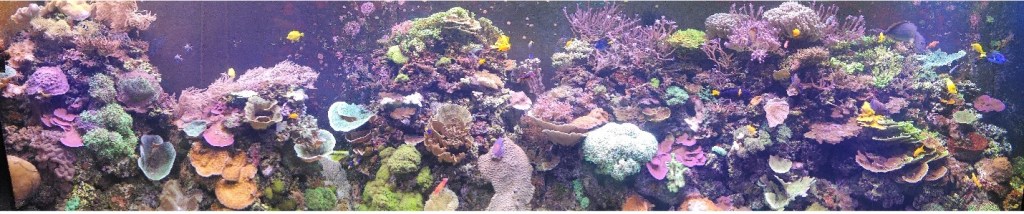
When we also consider that species’ morphologies (at both the colony and skeletal level) can become vastly different from wild type specimens due to factors including (but not limited to) depth, light, current, salinity, temperature, and length of time in aquaria, it becomes rather irrational to apply any species-level identification based solely on morphology. Regardless of the way in which these living collections have been attained, there seems to be unity in the desire of the institutions which house them to know exactly which species they have and where they came from. If this is not possible, then knowledge on whether, for example, Acropora ‘A’ is at least different from Acropora ‘B’, is a primary goal.
EUAC – The European Union of Aquarium Curators
In the spring of 2025, employees of European zoos and aquariums came together for a coral workshop at Burgers’ Zoo, Arnhem, Netherlands. Here I was given the opportunity to present some of my current research at the University of Essex, UK, which at the time included only specimens from ZSL. The research in question extracts ultraconserved elements from skimmed aquarium coral genomes, and combines these in a phylogenetic tree with wild topotype specimens collected primarily by Project Phoenix (see Bridge et al. 2024, Quattrini et al. 2024, and Rassmussen et al. 2025 for a similar approach). The more topotypes that are included, the greater the chance of assigning species identifications to aquarium specimens (see Bonito et al. 2021). Where clustering with topotypes does not occur, the methods still allow species delineations to be made both within and between aquaria. Perhaps most intriguing however to many of the participants, was the idea that the vast majority of coral identifications, even if made by ‘expert taxonomists’, are best treated with a high degree of dubiousness.
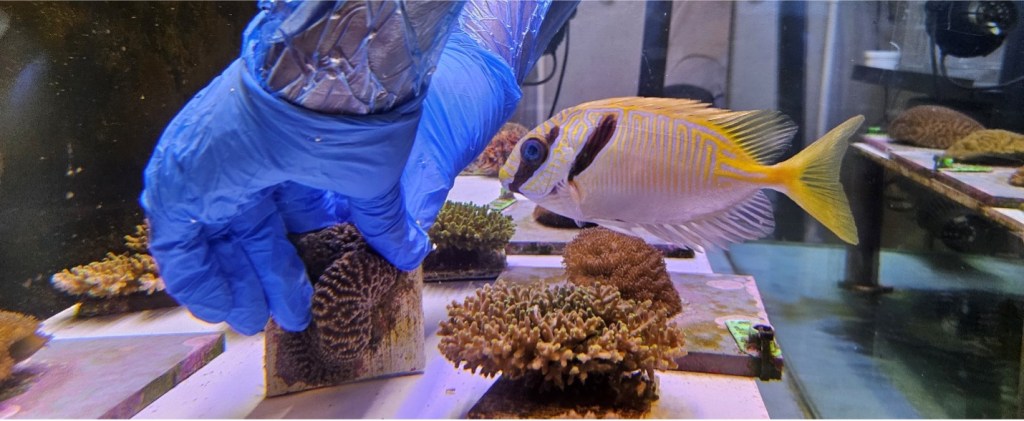
Subsequently, an additional five of the participating institutions of the workshop (Burgers’ Zoo, Netherlands; Horniman Museum and Gardens, UK; Aquazoo Düsseldorf, Germany; Maritime Museum and Aquarium, Sweden; and Musée océanographique de Monaco, Monaco) joined our project. An application was written to the EUAC (European Union of Aquarium Curators) ‘Funding for Ex-situ Projects’ grant and was successful. The funding facilitated the harvesting, DNA extraction, and sequencing of an additional 94 coral specimens shared equally between the five newly collaborating institutions. Though still in development, the project now involves around 190 scleractinian colonies representing 32 genera within 11 families, and supported by around 60 topotype specimens.
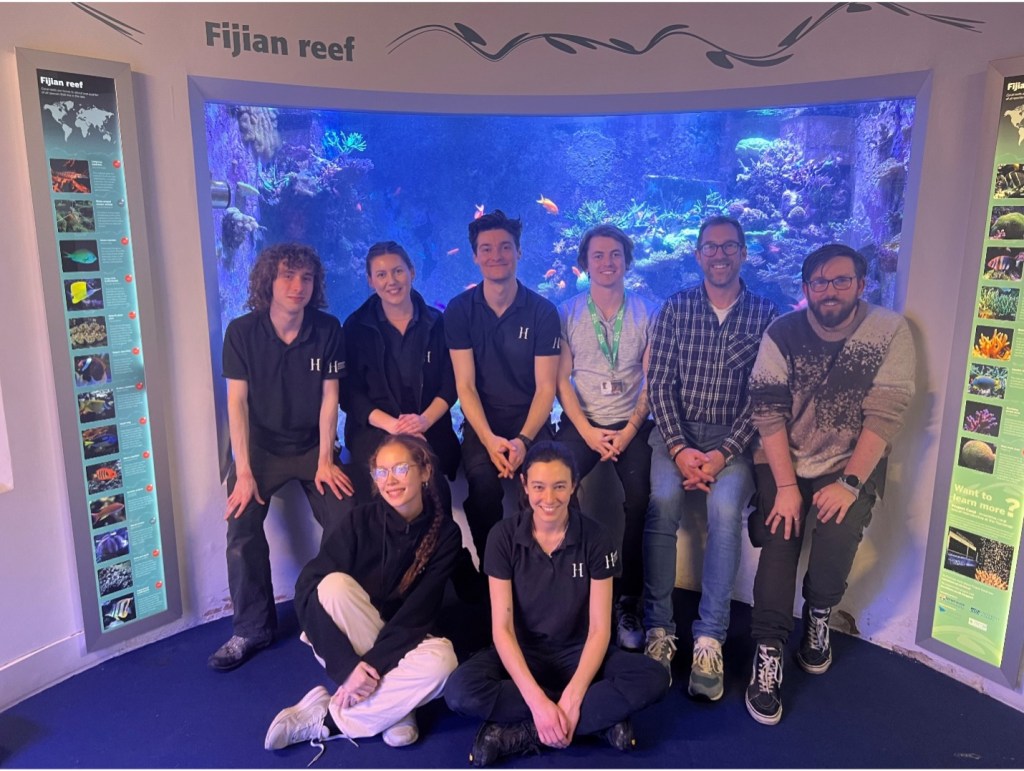
Aquarium Curator), myself, Jamie Craggs (Principal Aquarium Curator), and Arran Harvey Lead Aquarist at ZSL); front row from picture left: Alexia Backler and Felicity Kinsella.
The Next Steps
While the work described above is a positive start, there of course remains much to do. For institutions housing living collections and who wish to be involved in research and conservation, it is essential that all coral identifications are reevaluated following a cohesive open nomenclature. By doing so, not only can identity confidence values be easily communicated amongst curators and researchers, but the message that most current aquarium coral identifications are likely to be incorrect is reinforced. Continuing to convey the value and role of topotypes paired with reliable molecular tools will further help to ‘convert’ more aquarists towards this shared mission, especially when accurate species identification is a possible outcome – something that in my experience all aquariums strive to achieve.
If approached correctly, these accessible collections will certainly become more beneficial (and potentially crucial) to future coral reef conservation worldwide.
Works Cited
Bonito VE, Baird AH, Bridge T, Cowman PF, Fenner D (2021) Types, topotypes and vouchers are the key to progress in coral taxonomy: Comment on Wepfer et al. (2020). Molecular Phylogenetics and Evolution 159:107104
Bridge TCL, Cowman PF, Quattrini AM, Bonito VE, Sinniger F, Harii S, Head CEI, Hung JY, Halafihi T, Rongo T, Baird AH (2024) A tenuis relationship: traditional taxonomy obscures systematics and biogeography of the ‘Acropora tenuis’ (Scleractinia: Acroporidae) species complex. Zoological Journal of the Linnean Society 202:zlad062
Cowman PF, Quattrini AM, Bridge TCL, Watkins-Colwell GJ, Fadli N, Grinblat M, Roberts TE, McFadden CS, Miller DJ, Baird AH (2020) An enhanced target-enrichment bait set for Hexacorallia provides phylogenomic resolution of the staghorn corals (Acroporidae) and close relatives. Molecular Phylogenetics and Evolution 153:106944
Quattrini AM, McCartin LJ, Easton EE, Horowitz J, Wirshing HH, Bowers H, Mitchell K, González-García M del P, Sei M, McFadden CS, Herrera S (2024) Skimming genomes for systematics and DNA barcodes of corals. Ecology and Evolution 14:e11254
Rassmussen SH, Cowman PF, Baird AH, Crosbie AJ, Quattrini AM, Bonito V, Sinniger F, Harii S, Cabaitan PC, Fadli N, Tan C-H, Hung JY-H, Rongo T, Huang D, Halafihi T, Bridge TCL (2025) The tables have turned: Taxonomy, systematics and biogeography of the Acropora hyacinthus (Scleractinia: Acroporidae) complex. Invert Systematics 39:1–39

