Andrew Baird
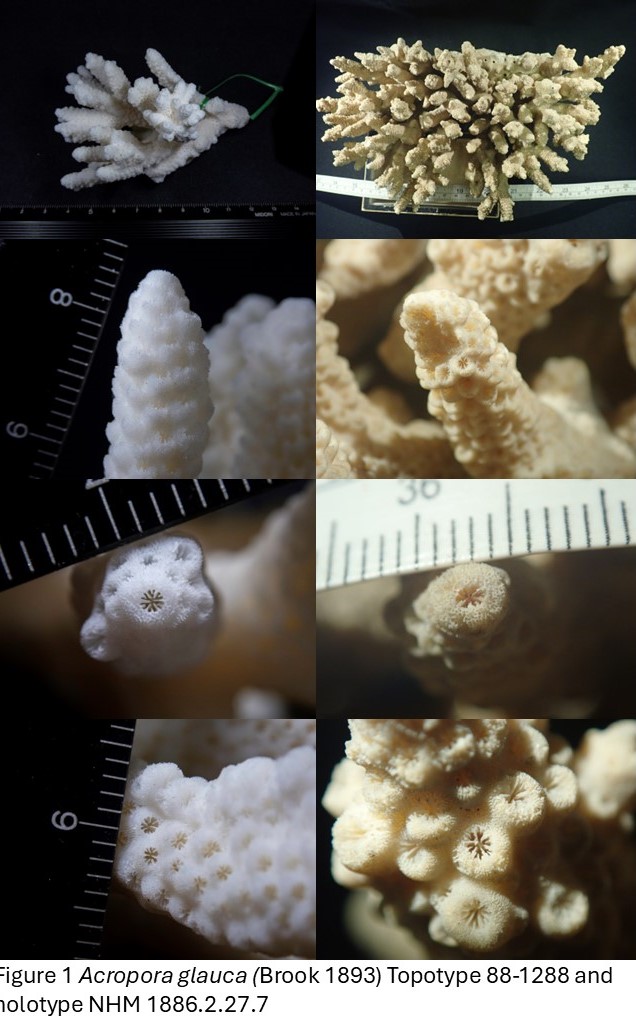
Acropora glauca was described by Brook (1893) based on a single sample purchased from Captain Beckett with a type location of “West Australia (WA)”. The holotype is curated in the Natural History Museum in London (Fig. 1).
The Corals of the World (CoTW) website suggests that A. glauca occurs throughout the Indo-Pacific, from Tanzania in the west to French-Polynesia in the east and from northern-Japan to the Solitary Islands, in the south. Acropora glauca has become the default species identification for any unusual tabular sub-tropical species probably due to the early records of the species in the sub-tropical Solitary Islands (Veron et al 1974) and northern-Japan (Veron 1992).
So, will the real Acropora glauca (Brook 1893) please stand.
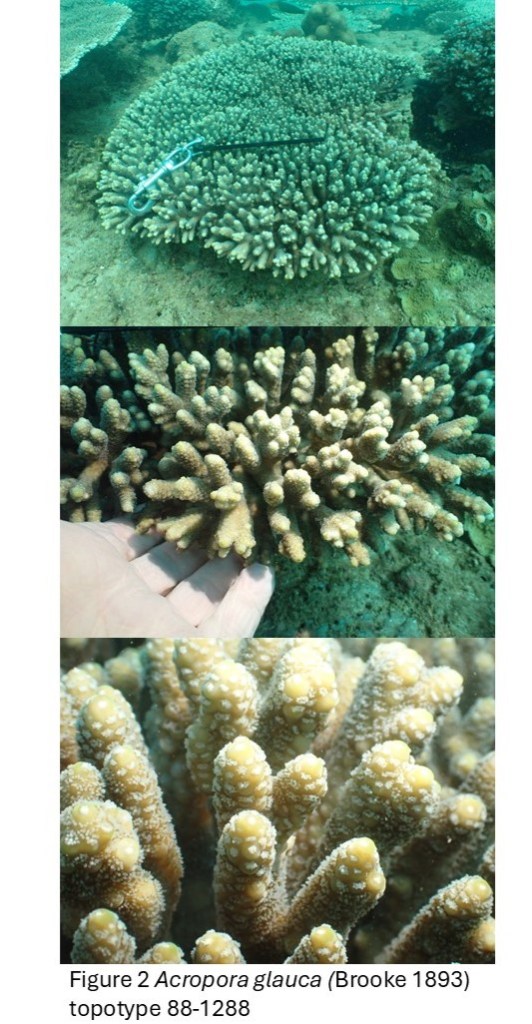
Project Phoenix’s unpublished molecular data, which includes a topotype for A. glauca from Exmouth Gulf, WA (Fig. 1 & 2), along with 3200+ samples from dozens of sites throughout the Indo-Pacific including the Solitary Islands and sites in southern Japan suggests that A. glauca is only found on Ningaloo Reef and in Exmouth Gulf. Therefore, every colony in every publication, every field guide, INaturalist, CoTW etc, etc that is identified as A. glauca and is not from Ningaloo or nearby is NOT-glauca .
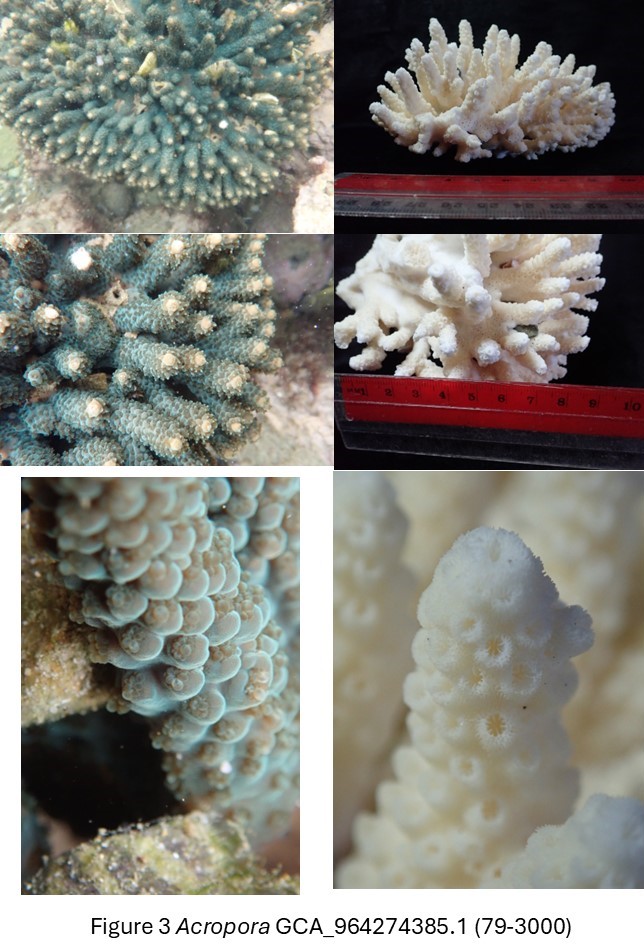
This includes the genome available at GenBank currently identified as A. glauca (GCA_964274385.1). This genome was developed from a specimen collected by me in the Solitary Islands (Fig. 3) and I sincerely regret giving the specimen a name. I knew at the time that it was almost certainly not glauca, despite some similarity to the type, and in the metadata I sent the Sequencing Team at Sanger I recorded it as A. cf_glauca. Unfortunately, the NCIB database does not tolerate an open nomenclature hence the genome is listed as A. glauca. Our unpublished molecular data suggest that this genome belongs to a soon to be described species restricted to the Tasman Sea and the southern Great Barrier Reef.
Unfortunately, this is not an isolated occurrence. Indeed, an analysis we completed at the end of 2024 suggested that 22 of the 24 Acropora genomes from the Indo-Pacific were incorrectly identified. So, if you are using these genome sequences in your phylogenies or to annotate your genes do not take the names at GenBank for granted. It is not much of an exaggeration to say that for scleractinian corals they are all incorrect.
References
Veron JEN (1992) Hermatypic corals of Japan. Australian Institute of Marine Science, Townsville
Veron JEN, How RA, Done TJ, Zell LD, Dodkin MJ, O’Farrell AF (1974) Corals of the Solitary Islands, central New South Wales. Aust J Mar Freshw Res 25:193-208


Pingback: The corals of north-Western Australia | Project Phoenix