By Andrew Baird
I have just returned from a thoroughly enjoyable and productive trip to the Lee Kong Chan Natural History Museum in Singapore.
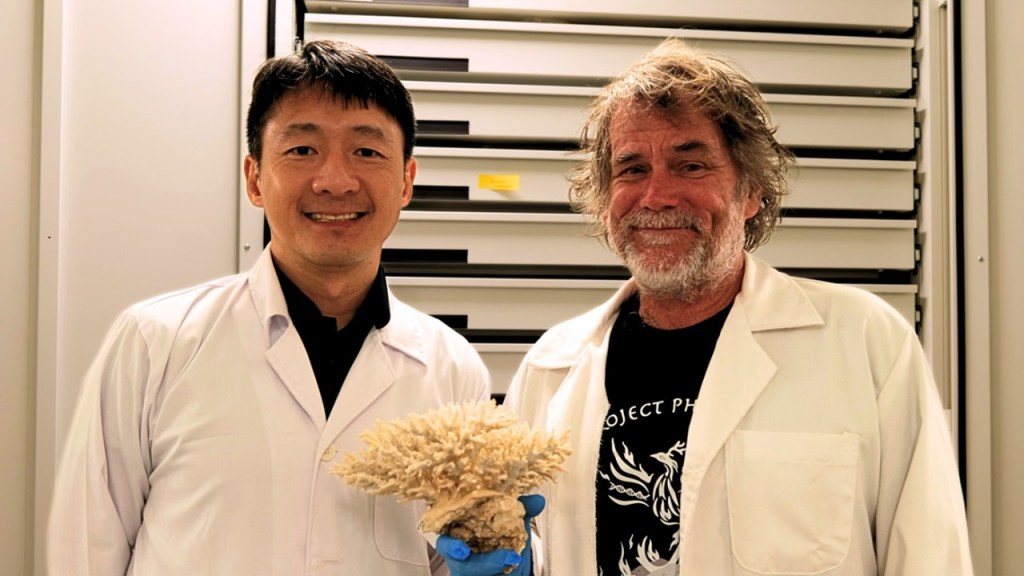
The visit was hosted by my close friend and long-term collaborator Dr Danwei Huang and the National University of Singapore (Fig. 1)
The primary aim of the trip was to search the Zoological Reference Collection (ZRC) at the Museum for potential topotypes for the 50 nominal species of Scleractinia from Singapore (see Crosbie et al 2026). Museum collections are an often-underused resources for biodiversity and systematics research. Indeed, our usual approach when hunting for topotypes is to collect in the field, but thanks to the visionary work of Danwei and previous curators of the collection, this was not necessary in Singapore because the collection includes preserved tissue of most of the recent specimens. Indeed, by comparing the morphology of the museum specimens to the type material – painstakingly curated by Project Phoenix with the kind assistance of curators from around the globe, in particular, Carsten Luter in Berlin and Hannes Brauer in Bern – Danwei and I were able to identify topotypes for all but 5 of 50 nominal species (Fig. 2).
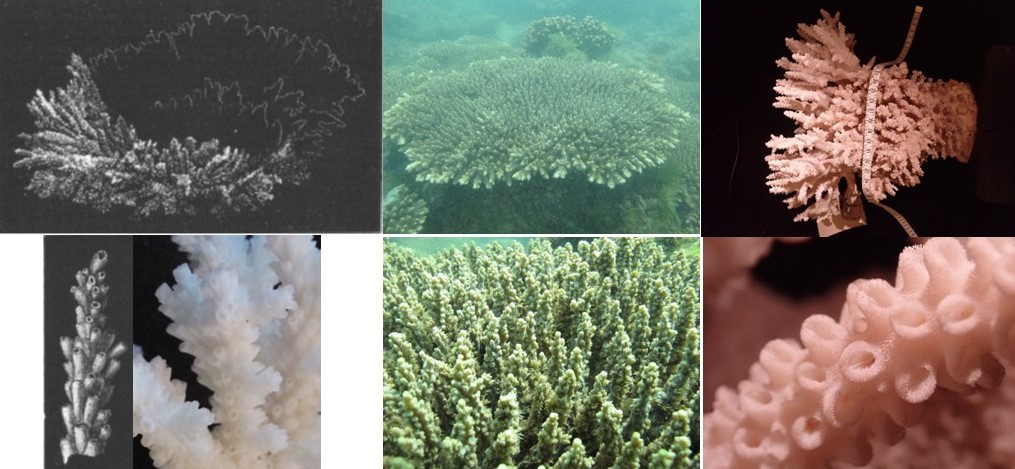
Figure 2. Acropora tenuispicta (Studer 1880). While the type is lost Studer included illustrations of the tabular mode of growth and the appressed tubular radial corallites. These features in the topotype 30-5219 are a good match for both. In contrast, the type of the senior synonym A. divaricata (Dana 1846) according to Wallace (1999) has tubular radials with nariform openings. Unpublished molecular data demonstrate that A. tenuispicta is Clade II sensu Cowman et al (2020) whereas the topotype for A. divaricata is clade V and restricted to Fiji and Tonga.
The coral fauna of Singapore remains a bit of an enigma as indicated by the taxonomic status of the 50 nominal species; only 11 are considered valid, 22 are considered junior synonyms and 15 are of uncertain taxonomic status. The topotypes will allow us to revisit the taxonomic status of each nominal species using modern integrated approaches, in particular molecular comparisons with other species.
I am not surprised that some topotypes remain elusive. The reefs of Singapore have gone through major changes since the type specimens of most of these 50 nominal species were collected in the late 1800’s. In particular, Isopora bruggemanni and Seriatopora elegans are almost certainly locally extinct. The ZRC includes numerous specimens collected in the 1980s and it would be very interesting to compare the species composition at this time to the contemporary coral fauna.
The ZRC is an extraordinary resource, however, there is still much work to be done. For example, the more recent specimens in the collection were identified within the Veron/Wallace taxonomic framework and therefore most are identified incorrectly. Interesting, the identification of specimens in the collection that predate the revisions of Veron and colleagues in the 1970s and 80s are generally more accurate and these identifications allowed us to locate two potential type II topotypes for species from the Sulu Sea.
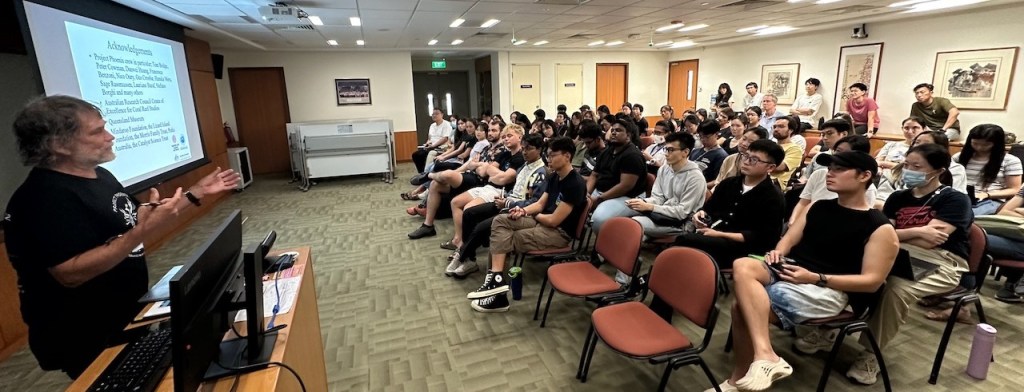
While in Singapore, I also had the chance to present the work of Project Phoenix to members of the Faculty of Science at the National University of Singapore (Fig. 3) and catch up with many old friends and colleagues in Singapore.
I thank Danwei, Tashfia and everyone else that helped make the trip a success.
References.
Cowman PF, Quattrini AM, Bridge TCL, Watkins-Colwell GJ, Fadli N, Grinblat M, Roberts TE, McFadden CS, Miller DJ, Baird AH (2020) An enhanced target-enrichment bait set for Hexacorallia provides phylogenomic resolution of the staghorn corals (Acroporidae) and close relatives. Mol Phylogen Evol 153:106944
Crosbie AJ, Bridge TLC, Mera H, Rassmussen SH, Cabaitan PC, Cowan PF, Gress E, Grinblat M, Horowitz J, Camilleri RE, Baird AH (2026) A nomenclature for the extant hermatypic scleractinian corals including type locations and taxonomic status for 2,338 nominal species. Memoirs of the Queensland Museum – Nature 67:1–10
Wallace CC (1999) Staghorn corals of the world. CSIRO, Collingwood

