Written by Andrew Baird
Two of the key features of the Project Phoenix approach to resolving the taxonomy and systematics of reef corals are firstly, the use of topotypes to serve as molecular archetypes of each species and anchors in phylogenies and secondly testing all the nominal species – not just those considered valid in the latest taxonomic revision. The rational for testing all the nominal species is that none of the numerous synonymies of the last century considered either molecular or morphological data and often demonstrated a surprising indifference to the type the material. The power of Project Phoenix’s approach is demonstrated in the recent publication by Crosbie et al 2026 in Invertebrate Systematics highlighted by the journal as the Editor’s Choice for this edition https://doi.org/10.1071/IS26023
In this landmark paper, Crosbie et al 2026 revisit the identity of 53 Acropora species – including 40 that were described based on specimens collected in eastern Australia – using an integrative approach combining genomic data, morphology, and close attention to the type material.
Of the 53 species evaluated, 47 were supported by these analyses. Among these, 12 names were removed from synonymy, and four species previously considered of uncertain taxonomic status can now be considered valid. The validity of six species was not supported resulting in one new synonymy, two changes to existing synonymies, and three synonymies being retained. One nomen novum = a new name was also established.
It is important to note that this far from the final say on the Acropora of eastern-Australia. Indeed, preliminary data from Project Phoenix suggests there are at least 120 Acropora species in eastern-Australia including dozens of undescribed species. These results indicate that current estimates of species richness in eastern-Australia are far too low and that some of these species are found only on the Great Barrier Reef.
At the time of submission, we had yet to find topotypes for 6 east-Australian nominal species of Acropora including A. brevicollis (Brook, 1892); A. latistella (Brook, 1892); A. recumbens (Brook, 1892); A. anthocercis (Brook, 1893); A. torihalimeda Wallace, 1994; and A. torresiana Veron, 2000. As discussed in Rassmussen et al (2025) we believe A. anthocercis has possibly gone extinct. Identifying a topotype for A. brevicollis was complicated due to uncertainty surrounding the correct type specimen (see coral of the moment). We now have candidate topotypes for A. latistella and A. torresiana so watch this space. While the validity of these six species remains to be tested, people should still keep an eye out for them in their travels. Ideally, people should consult the original descriptions when trying to locate these species rather than field guides like CoTW in which many species descriptions bear little resemblance to the species as conceived by the original authority.
In addition to the numerous improvements to the taxonomic framework of the Acropora perhaps the greatest strength of the paper is that it presents a model for the development of a robust taxonomy for the Scleractinia more generally. To quote one of the reviewers
“Beyond the numerous nomenclatural changes proposed, the greatest strength of the study lies in its development of a transparent, integrative taxonomic workflow that combines multiple independent lines of evidence into a repeatable framework”. This model approach will not only allows us to rapidly develop a workable taxonomic framework for the Scleractinia but also enable more accurate biodiversity assessments and more effective conservation of reef coral species.
Finally, it is important to note that more changes are in the pipeline once these species hypotheses are interrogated with more data, in particular, with topotypes from other nearby regions such as PNG or Fiji and other lines of evidence. For example, Acropora digitifera sensu lato is almost certainly at least two distinct species on the Great Barrier Reef, one species that spawns in spring and one species that spawns in autumn. One of the many unfortunate side effects of the Corals of the World framework is the artificial taxonomic stability it engendered, and which is now expected amongst the coral research community. I can see a time in the not-too-distant future where coral taxonomy is relatively stable, however, we are not there yet.
A summary of taxonomic actions recommended by Crosbie et al 2026
Twelve Nominal species removed from synonym
Acropora syringodes (Brook, 1892) removed from synonym with A. longicyathus
Acropora patula (Brook, 1892) removed from synonym with A. latistella
Acropora affinis is removed from synonymy with A. florida
Acropora australis is removed from synonymy with A. gemmifera
Acropora fruticosa is removed from synonymy with A. humilis
Acropora wallaceae is removed from synonymy with A. samoensis
Acropora otteri is removed from synonymy with A. secale
Acropora murrayensis is removed from synonymy with A. loripes
Acropora laevis is removed from synonymy with A. muricata
Acropora azurea is removed from synonymy with A. nana
Acropora pacifica is removed from synonymy with A. robusta
Acropora squamosa is removed from synonymy with A. millepora
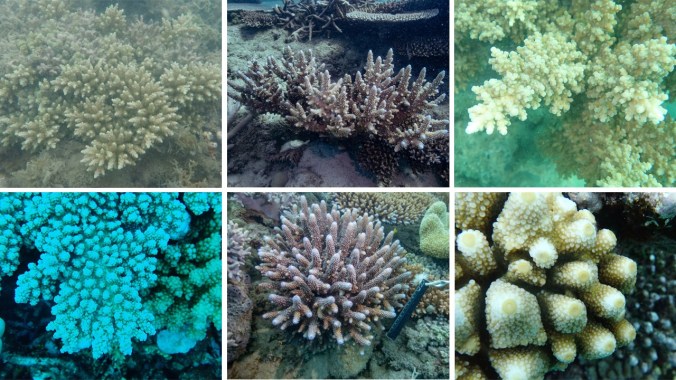
Figure 1. Acropora species back in the spotlight after decades in the dark. These species, considered to be varieties of other species in taxonomic revisions late last century, are now revealed to be independently evolving lineages valid following the use of modern integrated taxonomic approaches. Clockwise from top left; Acropora patula, A. wallaceae, A. syringodes, A. assimilis, A. fruticosa and A. australis. Photo credits; Andrew Baird, Tom Bridge and Augustine Crosbie
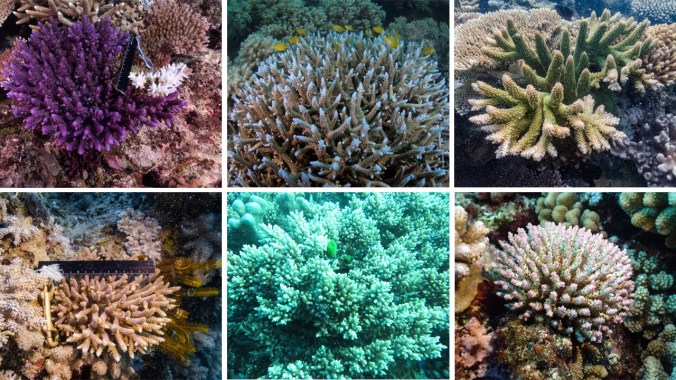
Figure 2. Acropora species back in the spotlight after decades in the dark. Clockwise from top left; Acropora otteri, A. leavis, A. pacifica, A. squamosa, A. murrayensis and A. azurae. Photo credits; Andrew Baird, Tom Bridge and Augustine Crosbie
Four taxon inquirenda now considered valid
Acropora bullata
Acropora jeulini
Acropora secundella
Acropora brooki = Acropora crosslandi
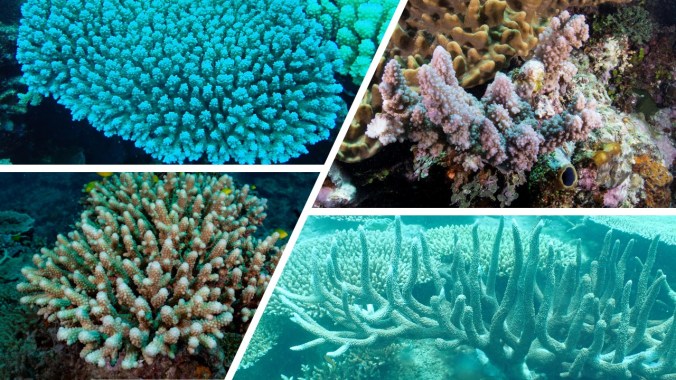
Figure 3. Acropora species ignored in the revisions of late last century. Clockwise from top left; Acropora crosslandi, A. jeulini, A. bullata and A. secundella Photo credits; Andrew Baird, Tom Bridge and Augustine Crosbie
Six synonymies – likely to change with more data
Acropora cardenae is a junior synonym of A. tenella.
Acropora leptocyathus (Brook, 1891) retained as a junior synonym of A. digitifera
Acropora baeodactyla (Brook, 1892) retained as a junior synonym of A. digitifera
Acropora exilis (Brook, 1892) retained as a junior synonym of A. elseyi.
Acropora decipiens is a junior synonym of A. pacifica
Acropora ambigua is a junior synonym of A. pacifica
One nomen novum
Acropora crosslandi as a nomen novum (replacement name) for A. brooki Crossland, 1952.
A summary of name changes for those familiar with the Veron Acropora framework on the Great Barrier Reef
Acropora humilis sensu Veron = A. bullata + A. fruticosa + A. humilis ++
Acropora hyacinthus sensu Veron = A. hyacinthus + A. pectinata + A. tersa + A. harriottae
Acropora tenuis sensu Veron = A. kenti + A. tenuissima
Acropora valenciennesi sensu Veron = A. secundella
Acropora millepora sensu Veron = A. squamosa
Acropora lutkeni sensu Wallace 1999 = A. otteri +
Acropora lutkeni Crossland 1950 is nonetheless a valid species in clade V sensu Cowman et al 2020 and one of many species misinterpreted by Veron (2000) due to a surprising indifference to the type material.
Acropora robusta sensu Veron = A. decipiens + A. ambigua
Acropora latistella sensu Veron = A. patella ++
Acropora cardenae sensu Veron = A. tenella
Acropora longicyathus sensu Veron = A. syringoides + A. longicyathus ++
Acropora florida sensu Veron = A. affinis + A. florida
Acropora nana sensu Veron = A. azurea
Acropora muricata sensu Wallace = A. laevis ++
Acropora loripes sensu Veron = A. murrayensis + A. loripes
Acropora anthocercis sensu Veron = A. kalindae ++
Acropora microclados sensu Veron = A. crosslandi ++

